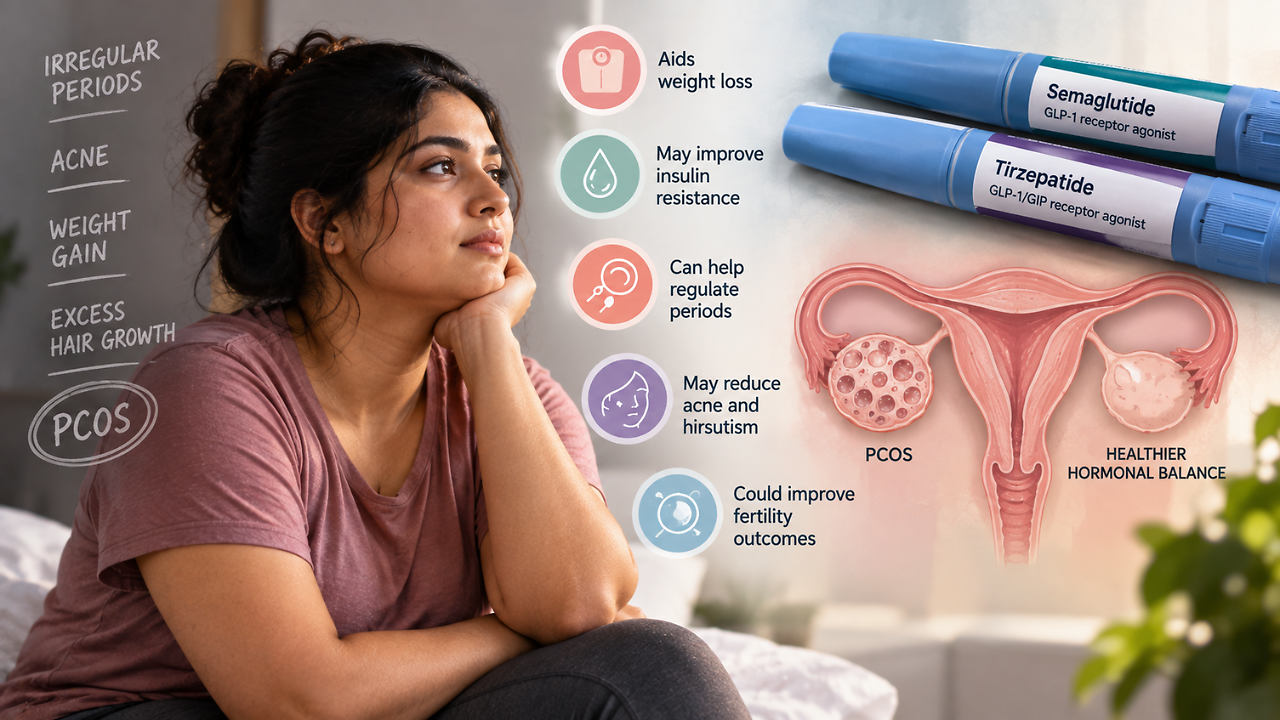
CFor years, polycystic ovary syndrome (PMOS) has been characterised with irregular periods, excess hair growth, infertility, and weight gain. But doctors have increasingly been emphasising that it is a far more complex condition. With metabolic conditions like insulin resistance, dyslipidaemia, fatty liver, and increased risk of diabetes forming an important part of the diagnosis, the condition has been rightly re-termed as Polyendocrine Metabolic Ovarian Syndrome (PMOS). When the metabolic symptoms of PMOS came into focus, a a newer class of medicines, GLP-1 receptor agonists like semaglutide, began attracting attention. Drugs like Ozempic and Wegovy were developed primarily for diabetes and obesity, not as universal treatments for PMOS. Yet their ability to help lose weight and improve metabolic health has raised an important question: are GLP-1 drugs actually changing how doctors treat PMOS, or are they simply becoming another tool for managing obesity and insulin resistance in women who also have PMOS? According to experts, the answer is not that simple. As September is PMOS Awareness Month, we take a closer look at how GLP-1 weight loss drugs are changing PMOS treatment. GLP-1 Drugs Target The Metabolic Side of PMOS HealthandMe spoke to Dr. David Chandy, Director of the Department of Endocrinology and Diabetology at Sir H. N. Reliance Foundation Hospital, Mumbai, who said that PMOS does not present identically in every woman. “GLP-1 drugs are changing the treatment of the metabolic component of PMOS, rather than becoming a treatment for every aspect of PMOS. PMOS is not a disease with one presentation. Some women are lean, some have significant obesity, some predominantly have menstrual irregularity or excess hair growth, while others have marked insulin resistance, prediabetes or diabetes.” Talking to HealthandMe, Dr. Sujith Ash, Consultant Obstetrician and Gynecologist at P. D. Hinduja Hospital & Medical Research Centre, Khar West, Mumbai, similarly stressed that PMOS needs to be understood as a broader metabolic and reproductive condition. “What you first need to understand is whenever we are thinking about PMOS, it is a huge umbrella under which a lot of organs are implicated. So, it is not just the period-related issues that we are dealing with, we are also dealing with liver implications where your metabolism is affected, memory and exhaustion, and insulin resistance.” Dr. Trupti Prasad, Endocrinologist at LH Hiranandani Hospital, told HealthandMe that the shift in understanding PMOS as a metabolic disorder is important when considering GLP-1 drugs. She said, “As we know, there is a change in the name of PMOS to PMOS. It's now more considered as a metabolic disorder rather than just focusing on the ovaries and reproductive functions.” She added that insulin resistance is one of the central mechanisms involved in PMOS and can have consequences beyond reproductive health. “GLPs are definitely one of the main core pathology, pathophysiology of PMOS is the insulin resistance. So one of the main mechanisms by which GLP would help here is insulin resistance and weight reduction. But insulin resistance comes with complications like dyslipidemia, cholesterol disorders and even fatty liver.”Also read: Weight Loss Surgery May Improve Irregular Periods And Other PMOS SymptomsHaving PMOS Does Not Automatically Mean You Need Ozempic Or Wegovy One of the biggest concerns surrounding GLP-1 drugs is the perception that a woman with PMOS and excess weight should automatically be prescribed one. Experts warn against this strategy of treatment. “Having PMOS alone is not an indication to start a GLP-1 drug.” Chandy said. “The first question should be whether the woman has overweight or obesity significant enough to justify medical treatment according to accepted obesity-treatment criteria.” He said GLP-1 treatment becomes more relevant when excess weight is accompanied by metabolic complications. “I would particularly consider it when there is significant excess weight or central obesity with problems like insulin resistance, prediabetes, type 2 diabetes, fatty liver, dyslipidaemia or other weight-related complications, especially when lifestyle measures alone have not achieved sufficient results.” Conversely, she said a woman with lean PMOS or someone seeking to lose a small amount of weight for cosmetic reasons should not automatically be placed on semaglutide. Prasad said doctors also use BMI and the presence of metabolic complications when considering these medications. She also noted that Indian thresholds can differ from Western obesity criteria because metabolic diseases can occur at lower BMI levels in Indian populations. “We use a cut-off of 25 with one comorbidity or above a 27 BMI irrespective of comorbidity. So the patient with this criteria of a BMI of 25 and has a PMOS obviously would go for the GLP-based therapies.” Ash said assessment should go beyond weight alone. He says, “The other thing would be insulin resistance. We ask for a fasting insulin level in these patients along with the sugars and the cholesterol and the lipid profile basically, your fasting blood sugar, your HbA1c.”Also read: Thin Outside, Fat Inside: Why A Slim Body May Still Hide Metabolic Health Risks?Effects Of GLP-1 Drugs On Other Symptoms Of PMOS Weight loss is currently the most established effect of GLP-1 drugs in this context. But researchers and clinicians are also interested in whether the improvement in metabolic health can translate into changes in other features of PMOS. Dr. Chandy said the evidence is strongest for metabolic outcomes like weight reduction and insulin resistance. There are also signals of reproductive benefits, although the evidence is not equally strong for every outcome. Dr. Chandy said, “There is encouraging evidence that menstrual cycles may become more regular. Some studies show improvements in sex hormone-binding globulin and modest reductions in androgen levels.” However, he cautioned against treating these findings as established evidence that GLP-1 drugs directly treat every manifestation of PMOS. He added, “The effects on hyperandrogenism are inconsistent, and we do not yet have sufficiently strong evidence to say that GLP-1 drugs are treatments for hirsutism or acne.” Dr. Ash explained why improving insulin resistance could have effects that extend beyond body weight. He said, “When I'm looking into the insulin resistance picture of PMOS, the major effect in the patient is not just the weight. It is the insulin that leads to the androgenic effects.” He said insulin resistance can contribute to menstrual abnormalities and other symptoms. According to Dr. Ash, improving insulin sensitivity can reduce hyperinsulinaemia and potentially influence androgen levels and menstrual regularity. “When GLPs are introduced in your body, GLPs will improve the insulin sensitivity. And once the hyperinsulinemia reduces, then that will help in suppressing the appetite. So, then weight balancing is better. Also, with the insulin resistance becoming better, the androgenic levels or the male hormone levels, which are increased in PMOS, PMOS, that is also better.”Also read: From Insulin Resistance to Fertility: Understanding the Metabolic Side of PCOSGLP-1 Drugs Vs Metformin Metformin has long been used in PMOS treatment, particularly when insulin resistance and metabolic abnormalities need to be addressed. The arrival of GLP-1 drugs has therefore raised the question of whether they could eventually replace the older drug. Experts say that is not how the comparison should currently be viewed. Dr. Chandy said both drugs are meant for different conditions. Metformin has decades of clinical use behind it, while GLP-1 drugs generally produce substantially greater weight loss. The expert said, “Metformin has been used in PMOS for decades. It is inexpensive, we have extensive long-term safety experience, and it remains useful particularly for insulin resistance and metabolic abnormalities. GLP-1 drugs generally produce much greater weight loss than metformin. Therefore, in a woman with PMOS and significant obesity, a GLP-1 drug may have a much larger metabolic impact.” Prasad similarly said GLP-1 drugs could offer an advantage when significant weight reduction is a major treatment objective. But she said it is too early to conclude that GLP-1 drugs will replace metformin. Dr. Ash highlighted the fact that there is a depth of long-term evidence. He said, “The only deciding factor is that the effects are quicker in GLPs, but it is not something that I can do for a long period. Whereas metformin, I can do it for a longer period. And there are not enough studies which are based around the preconception and pregnancy aspects along with GLPs, which are there with metformin.”Also read: Meet Louise Brown- The World’s First IVF BabyCould Better Metabolic Health Improve Fertility? One of the most intriguing parts of the GLP-1-PMOS conversation is fertility. Some women report that their periods become more regular after losing weight on GLP-1 drugs. For women whose PMOS is associated with insulin resistance and irregular ovulation, this can improve the hormonal environment needed for ovulation. But experts caution against interpreting this as proof that semaglutide itself is a fertility drug. Chandy explained that improving insulin resistance can improve reproductive effects. He said, “When a woman with PMOS loses significant weight and insulin resistance improves, insulin levels fall. High insulin levels can stimulate the ovary to produce more androgens and can interfere with normal follicular development and ovulation.” There may be biological effects of GLP-1 signalling on reproductive issues as well, but Chandy said the clinical significance of these findings remains uncertain. “There may also be direct effects of GLP-1 signalling on the reproductive system and the ovary, and there is interesting experimental research in this area. But clinically, I think it is premature to say that semaglutide is directly stimulating fertility.” Women With PMOS Trying To Conceive & GLP-1 Drugs This is where the difference between improving metabolic health before pregnancy and taking a GLP-1 drug during pregnancy becomes important. Prasad said this preconception can influence pregnancy outcomes. “Pre-pregnancy parameters are very important in deciding upon what complications arise during the pregnancy. So ideally a normal body weight before pregnancy, even HB1C control should be less than 6.5, normal blood pressure, that is what we look for once a person goes for pregnancy.” She said GLP-1 treatment can help women before conception, but the medication needs to be stopped before pregnancy. She said, “We have to stop at least two months prior to a planned pregnancy. So current data is not there for use during the pregnancy.” Chandy similarly said GLP-1 drugs may have a role as a preconception metabolic intervention, rather than a pregnancy or fertility treatment. He also addressed the issue of discontinuing treatment. Dr. Chandy said, “Another important issue is weight regain. Once GLP-1 therapy is stopped, appetite can increase again and some weight may return. So we need a long-term plan involving nutrition, physical activity and, where appropriate, other metabolic treatments rather than simply stopping the injection and hoping that the benefit remains permanently.” As GLP-1 drugs become increasingly popular, doctors say one of the biggest risks is reducing a complex condition to a prescription for weight loss. Chandy said PMOS remains a lifelong reproductive and metabolic condition and GLP-1 drugs do not cure it. He also cautioned against viewing GLP-1 drugs as fertility medications. He said for women with PMOS and anovulatory infertility, established fertility treatments remain important. He said, “The second misconception is that these medicines are fertility drugs. Some women certainly notice more regular periods and may start ovulating after significant weight loss, but that actually means that pregnancy can become possible unexpectedly. Women need to be counselled about contraception because these drugs should not be used during pregnancy.” Ash said patients also need to understand that medication alone cannot substitute for sustained lifestyle changes. “The entire idea of using any of the GLPs is that in that few months that we are doing the GLPs, you have to make sure your lifestyle changes even more disciplined, more religious and you follow that lifestyle. So the important part is forming the lifestyle as a habit which will continue for a longer period.” Prasad stressed that the metabolic component of PMOS requires long-term attention rather than a short course of treatment. “I want patients to understand that PMOS, as the name suggests, it's a metabolic complication which remains within the person throughout their life. It's not only about the ovaries, not only about the irregular periods or about the infertility issues. It's something which starts maybe like in a young age and it remains with you throughout your life.”