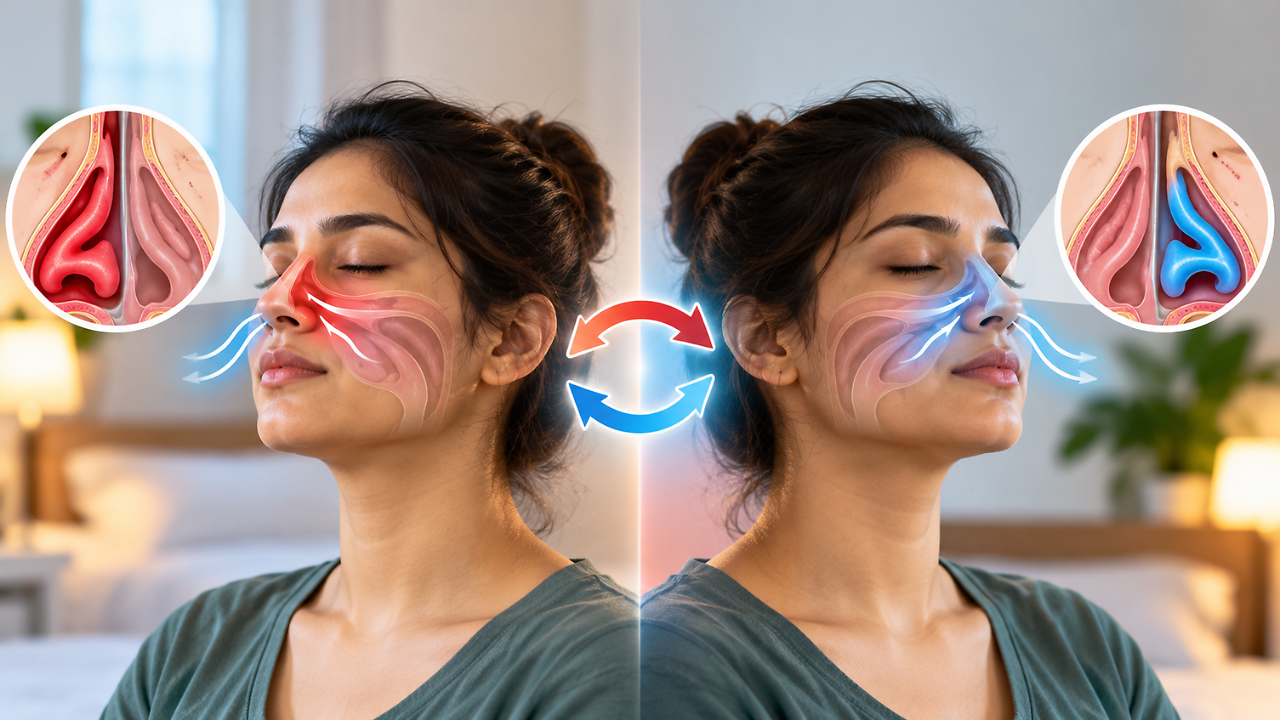
Nasal passages breath for us. Our nose plays an important role in breathing. We are naturally designed to breathe mainly through our nose, which helps warm, filter & humidity the air before it reaches our lower passage & lungs.Interestingly, both sides of nose do not work equally at the same time. Naturally, one nasal passage becomes slightly more congested (swollen) while the other remains more open. After few hours, they gradually switch roles. This normal & continuous process is called the nasal cycle.This allows one side of nose to take some rest, maintain moisture & then get back to work again!!Very few people can really understand or make note of this particular arrangement.This is called as nasal cycle. One nostril works at a time and other takes rest. They switch their role every few hours.What Happens Inside The Nose During The Nasal Cycle? Also read: Decongestants Aren't Always Safe: NHS Warning Urges Brits To Avoid Common Medication- Tips To Manage Nasal CongestionWe have lining covering our both nasal passages including small bones present on both sides. It has tendency to swell and shrink with the nasal cycle.The nasal cycle can become more noticeable when a person has a cold, allergy, sinus inflammation, or other causes of nasal swelling. In such situations, the normally resting side may become significantly more blocked.When Nasal Blockage May Point To A Deviated Septum Another common reason for increased nasal blockage is a deviated nasal septum. Septum is a partition between both nostrils, Ideally it lies in the centre. When a person has deviated nasal septum partition between both nostril is not in the centre.It is more on one side than the other making one passage narrower than the other.Such individuals notice blocks more frequently. You can understand here that the narrower the passage, the more noticeable even a small amount of swelling can become.Understanding the nasal cycle helps us recognize that changing nasal blockage from one side to the other can sometimes be a normal part of how our nose works.By Dr. Smita Nagaonkar, Additional Director, ENT - Voice & Swallow Disorders, HN Reliance Foundation Hospital, Mumbai