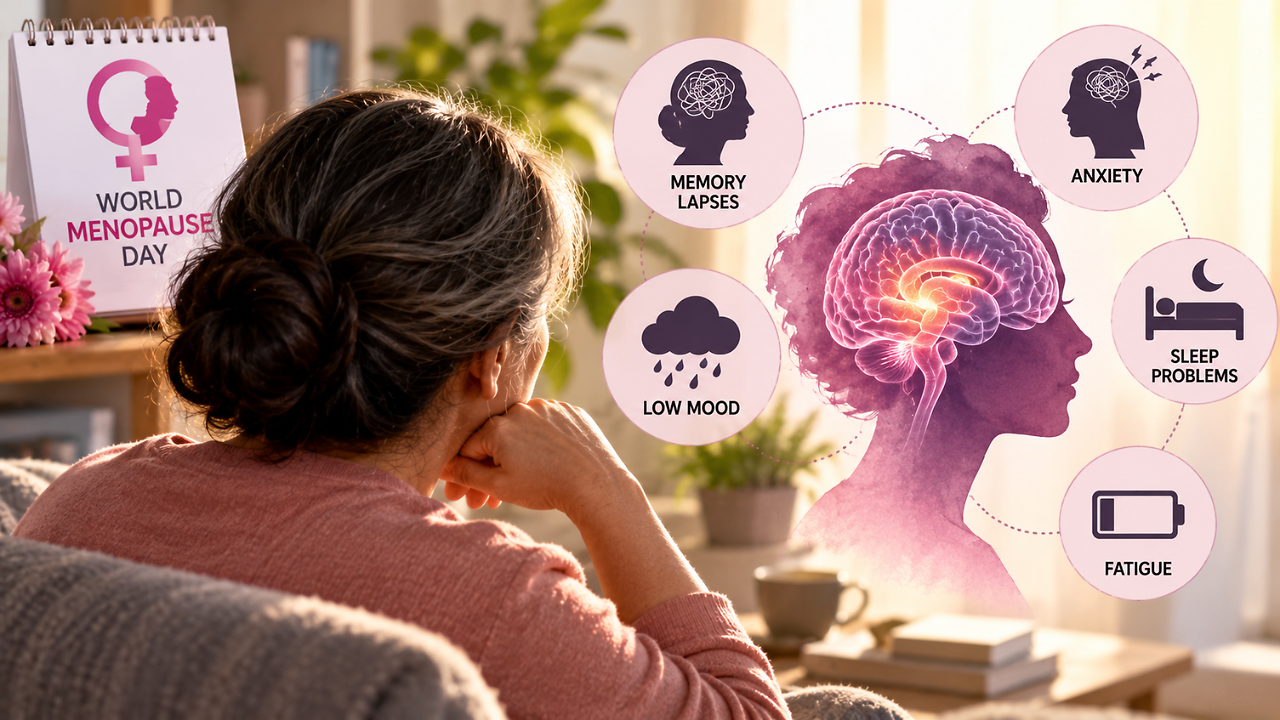
Menopause is often characterised symptoms like by hot flashes and night sweats. But for some women, the transition can also bring changes in mood, memory and concentration that may be harder to identify. These symptoms can affect everyday life and may be misconstrued as stress, ageing or the emotional effects of children leaving home.On World Menopause Day 2026, Dr. Abha Majumdar, gynaecologist and one of the lead IVF specialists in the country, told HealthandMe that women and their families need to identify the least obvious symptoms of perimenopause, the transition leading up to menopause.Menopause Symptoms Dismissed For Empty Nest Syndrome Empty nest syndrome refers to the feelings of grief, loneliness or loss of purpose that some parents experience when their children leave home to study, work or start their own families. The transition can bring changes to family routines and relationships, especially for parents who have spent years raising their children. Dr Abha points out that mood changes in women during their 40s should not automatically be attributed to empty nest syndrome. Perimenopause, the transition leading up to menopause, can also involve mood swings, forgetfulness and difficulty managing everyday tasks. As she puts it, “Suddenly, around 45 or around that time, she starts feeling depressed. Everyone says, "Oh, children have grown up, you know, it is like an empty nest. But it is not just an empty nest.”Recognising the symptom is key so that women experiencing new or persistent symptoms are not dismissed as simply struggling with their children leaving home, and can seek medical advice when needed.Also read: World Menopause Day 2026: Perimenopause Can Begin In Your Late 30s. What Changes Should You Watch For?Symptoms Not Related To Menstrual CyclePerimenopause can bring changes that don't relate to menstrual or hormonal cycle. Women may find themselves to be forgetful about routine things, struggle to concentrate or feel overwhelmed by tasks they previously managed with ease.Dr Abha explains how these changes may appear in everyday life. She said, “She starts forgetting. She starts finding it difficult to cope with the daily chores which she did very easily before that.”She says women may also face cognitive symptoms like brain fog and mood swings during this phase. She said, “Forgetfulness, cognition difficulties, brain fogging, mood swings.”These symptoms can be confusing when women do not know that they come with menopausal transition. Changes in mood, for instance, may be misconstrued as reaction to family responsibilities, work stress or other pressures, while difficulties with memory and concentration may completely go unnoticed.Also read: Menopause Abruptly Shifts Bones, Liver And Blood Fats, Study FindsPerimenopause Duration Perimenopause does not begin at the same age for everyone. Also, the transition may continue for several years before menopause sets in.Dr Abha said that perimenopause may last for five or even 10 years before menopause sets in. She also said that fluctuating oestrogen levels are part of this phase. “She's probably going through a perimenopause, which is it estrogen deprived and then comes up, goes down and comes up, and goes down and comes up. It may take couple of years for menopause to set in," she said. Since the transition can be prolonged, understanding its symptoms is important for women as well as their families. Dr Abha explains that husbands and adult children should be attentive to changes in a woman's behaviour, mood or ability to manage familiar routines, rather than dismissing them.She also stresses that women's health after menopause deserves attention, particularly as life expectancy increases.She said, “Please support her at that time because she's got 25 years more to live right away. Maybe more.”Medical Attention Mood changes, fatigue, sweating and memory difficulties should not automatically be attributed to menopause. Other health issues can produce similar symptoms, which makes medical attention important.Dr Abha advises women to seek help whenever they notice a change that makes everyday activities more difficult.She said, “Any point. If she feels something is happening to her, she's not being able to cope with her daily chores. She used to cook so effortlessly, now it takes a lot of effort. She starts getting tired, she sweats. That is the time. May it be 40, may it be 45, may it be 38 also.”A doctor can assess menstrual cycle and determine whether symptoms are related to perimenopause or another condition. Dr Abha says investigations may also help identify other possible explanations, including vitamin deficiencies or thyroid problems.“So, they can be sorted out. So don't avoid going to a doctor if you feel something is changing in your body. And what you were coping with earlier, you're not being able to cope with that.”