
- Health Conditions A-Z
- Health & Wellness
- Nutrition
- Fitness
- Health News
- Ayurveda
- Videos
- Medicine A-Z
- Parenting
RFK Jr Plans To Issue Dietary Guidance Urging People To Eat More Saturated Fats, But Is It Safe? Here's What Health Experts Say
Credits: Wikimedia Commons, Canva
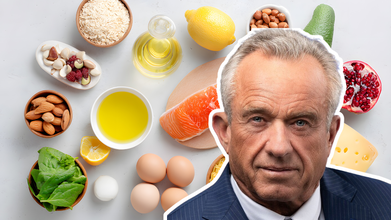
Robert F Kennedy Jr., the health and human services (HHS) secretary has now planned to issue guidance to encourage Americans to eat more saturated fats. This guidance, if issued, would contradict the decades of dietary recommendations and alarming experts. This has had mixed views from those in the healthcare sector.
Cheryl Anderson, an American Heart Association board member and professor at the University of California, San Diego's school of public health and human longevity science told the Guardian, "My response and sort of counsel to myself was to stay calm, and let’s see what happens, because there was no indication given as to how, why, when this potential shift would occur."
Anderson also added, “The recommendation around saturated fat has been one of the most consistent recommendations since the first edition of the dietary guidelines.”
However, Ronald Krauss, who is a professor of pediatrics and medicine at the University of California, San Francisco has researched saturated fats. He found that saturated fats in fact, could be less harmful than previously thought. To this upcoming planned guidelines, he says, "If [Kennedy} is actually going to go out and say we should be eating more saturated fat, I think that's really the wrong message."
What Does The New Research On Saturated Fats Show?
Krauss's research shows that "saturated fat is relatively neutral" as compared to what scientists had believed earlier. Kennedy too has indicated that in the new guidelines, more stress will be placed to "eat saturated fats of dairy, good meat, of fresh meat and vegetables". The Hill reports that Kennedy said, "When we release those [guidelines], it will give everybody the rationale for driving it into our schools."
As per Krauss's studies, reducing saturated fat intake is only helpful when you replace it with the right things. For instance, replacing saturated fats with unsaturated fats like olive oil and "polyunsaturated fats from other plant sources can really improve metabolic health and reduce heart disease risk, but that’s not saying that saturated fat is necessarily harmful".
His research also focused that replacing saturated fats with sugar and carbohydrates then could increase risk of heart diseases.
Krauss noted that setting strict cutoff points for saturated fat intake, such as the current 10% limit, can often feel arbitrary.
Anderson, however, pointed out that regardless of the exact threshold, data clearly show a pattern: higher saturated fat consumption in a population correlates with increased cholesterol levels and greater cardiovascular disease risk.
While she agrees with Krauss that what replaces saturated fat in the diet is important, Anderson disagrees that saturated fat itself is “neutral.”
“In the current American diet, there’s simply too much saturated fat, and it’s not having a neutral impact on public health,” she said.
Despite differing views, both Anderson and Krauss agree that future nutritional guidelines should focus less on single nutrients like saturated fat and more on overall dietary patterns. Anderson's explanation is that people do not eat nutrients, they eat foods. "When you ask someone what they had to eat, they don't tell you: 'I had fat, or I had carbohydrate, or I had protein."
This is why, as per Anderson, focusing on food is more important and less confusing than focusing on the nutrients.
Is Your Excessive Salt Consumption Increasing Your Risk Of A Stroke?
Credit: Canva
While the World Health Organization recommends 5g or a tablespoon of salt every day, Indians consume more than double, increasing their risk of having a fatal stroke exponentially.
According to EatRightIndia, Indians consume about 11g of salt each day through meals which can significantly increase their risk of high blood pressure, strokes and hypertension.
Hypertension causes over 1.6 million deaths annually, accounting for nearly 18 percent of all fatalities and heavily contributes to deaths caused by heart disease, stroke and kidney disease.
What Is Excessive Salt Dangerous?
The most important side effect of consuming excessive salt intake is high blood pressure. Salt causes the body to retain water, increasing the volume of blood in your vessels and leading to elevated pressure levels. If your blood pressure consistently measures over 140/90 mmHg, it's time to evaluate your salt consumption.
Over time, this can rapidly raise your risk for heart disease, stroke while also potentially contributing to stomach cancer and weakened bones. Additionally, high blood pressure damages kidneys and excess sodium can lead to kidney stones or disease.
Apart from a 5gm recommendation for adults, NHS suggests that children between seven to 11 years of age should not eat more than 5g of salt while those between four to six years of age should eat less than 3g of salt every day to maintain heart health.
How Can You Reduce Your Salt Consumption?
Both excessive and insufficient salt intake have been linked to adverse outcomes. Achieving the right balance is critical, and the best approach is to minimize processed food consumption rather than relying solely on the salt shaker.
Common items such as pickles, paapads, chutneys, salads and buttermilk significantly contribute to daily salt consumption. Hidden salts in packaged goods like biscuits, sauces, condiments and snacks also can increase your salt intake.
To cut down on your salt intake, experts recommend:
- Not adding salt in rice and dough for chapati, poori and paratha.
- Not sprinkling salt on salad, cut fruits, cooked vegetables or curd.
- Gradually reducing the salt usage while cooking from lesser to least.
- Limit food accompaniments like salted butter, salty spice mixes (chaat masala, jal jeera masala etc.), chutneys, pickles, ketchups, sauces and dressings as they contain excess salt.
- Baking soda, baking powder, and monosodium glutamate (MSG) also contains high sodium and should be avoided in your daily cooking.
- Not keeping salt on the table.
- Buying tinned vegetables, pulses or fish in water instead of brine.
- Being aware that some dissolvable tablets, such as painkillers, vitamins or prescription medicines, may be high in salt.
This Low-Calorie Sugar May Be The Safest Alternative For Diabetic Patients, Scientists Say
Credit: Canva
Tagatose, a natural sugar with a third of the calories of table sugar, may be the up-and-coming safe alternative to unhealthy added sugars, scientists say.
Researchers from Tufts University, Massachusetts in partnership with biotechnology companies Manus Bio (US) and Kcat Enzymatic (India), claim that tagatose, found in only small amounts in some dairy products and fruits, is a healthier option than regular sugar and sweeteners.
The experts also claim it this rare natural sugar also does not cause insulin spikes, making it safe for consumption for both Type 1 and 2 diabetes patients. Tagatose has also been previously recognized as safe for consumption by the US Food and Drug Administration (FDA) and the World Health Organization (WHO).
Certain studies have also found tagatose to be 'tooth friendly', as it can limit the growth of harmful microbes in the dental cavity and prevent tooth decay as well as cavities.
How Is Better Than Other Artificial Sweeteners?
Due to being a natural sugar with similar taste and bulk to sugar but fewer calories, minimal blood sugar impact, prebiotic benefits and heat-stable for baking, tagatose is known to better than artificial sweeteners.
Moreover, it also lacks the bitter aftertaste common with some artificial sweeteners such as saccharin and stevia and tastes 92 percent as sweet and 60 percent less calories than common sugar.
With low calories and low absorption, tagatose is an attractive bulk sweetener, meaning it can not only can replace sugar for sweetness but can also provide a similar bulk texture in cooking that comes with adding the sugar in some quantity, something that high intensity sweetener substitutes are unable to do due to their composition.
Can Diabetes Patients Consume It?
Yes, tagatose can be eaten by insulin-resistant people as it's only partially absorbed in the small intestine; much of it being fermented by gut bacteria in the colon. Because of this, its impact on blood glucose and insulin is much less than that of conventional sugar.
Clinical studies show very low increases in plasma glucose or insulin after ingestion of tagatose. However, in the gut, the rare sugar is metabolized in a similar way to the fruit sugar, fructose, meaning those with fructose intolerances may want to steer clear
Where Can I Buy It?
While tagatose is far more beneficials than other commercially-available sugars, it remains unavailable due to limited production. "There are established processes to produce tagatose, but they are inefficient and expensive," explains biological engineer Nik Nair from Tufts.
But it can still be found in milk and other dairy products when lactose is broken down by heat or enzymes, such as yogurt, cheese and kefir. Along with this, fruits such as apples, pineapples and oranges also contain trace levels of tagatose as part of their natural carbohydrate spectrum.
Oncologists' Food Guide To Keep Cancer Cells At Bay
Credits: Canva
Cancer cells do use oxygen to metabolize sugar(glucose) to generate energy for their sustenance. They use anaerobic respiration i.e. glycolysis. Cancer still remains a prominent cause of mortality across the globe. Despite recent breakthroughs in the treatment strategies, the understanding of how cancer begins inside a cell remains elusive.
Traditional treatment pathways such as chemotherapy, radiation therapy and even surgery, although inevitable, are still falling short in effectively eradicating certain malignancies. In many cases, they aren’t fully able to restrict the disease progression, causing systemic toxicity which further can have its own complications.
However, we find ourselves in an interesting place where growing research is making us look at cancer in newer ways. For the first time, cancer is being considered as having metabolic irregularities as a major cause in addition to genetic aberrations. This might change the way we treat the disease in the coming days.
Cancer cells breathe differently
Interestingly, new age theories are observing some commonality among all cancers, the affected cells generate energy differently.
Cancer cells are not using oxygen to generate energy. Instead, they are fermenting glucose and glutamine (an amino acid found in the body) to fuel their growth. This impaired cellular respiration might be at the core of disease formation.
Dr Thomas Seyfried (a leading proponent of the metabolic theory of cancer) has gone ahead in saying that infected mitochondria (powerhouse of the cell) is the propeller of the disease and not the nucleus (where genetic material is stored inside a cell). It might be the kitchen of the cells that is calling the shots.
Starving cancer cells could be a way forward
Healthy human cells can use liver-generated ketone bodies for energy production in the absence of glucose. However, cancer cells are incapable of fermenting ketone bodies.
If tumors thrive on glucose and glutamine, removing these fermentable fuels can enable starvation of cancer cells. They can easily shrink or even disappear. On the flip side, chronically elevated blood glucose can contribute to the progression of the disease.
Growing research propagates the induction of a ‘calorie-restricted’ diet for both prevention and management of cancer.
It is being observed that therapeutic ketosis using carbohydrate-restricted diets alongside traditional treatments (chemotherapy, surgery et al) is showing clinically positive results in cancer patients. In my own office, I have seen similar experiences where my patients benefitted from a holistic approach to cancer treatment which included tailored low glycemic diets.
The standard treatment in form of chemotherapy, radiation and surgery are cytotoxic methodology; dietary interventions and Indian traditional medicine break the resistance of cancer cells and make them amenable to cytotoxic treatment simultaneously decreasing the adverse effects of cytotoxic treatment.
While aggressive keto diets can be a late-stage intervention, maintaining a moderately calorie-restricted diet can be adopted as a preventive measure against the rise of cancer.
Finding a middle path
Cancer researchers might have theoretical disagreements but most of them agree on the fact that there are multiple factors involved in conversion of a normal cell into a tumour. Hence, having a holistic approach to the treatment is the way forward.
While standard treatments like chemotherapy, radiation therapy and surgery are not replaceable, the systemic toxicity caused by these aggressive treatments is reduced as well as response to them is augmented using holistic approach with dietary intervention and Indian traditional medicine, under the supervision of skilled professionals.
Note: Conventional treatments like chemotherapy, radiation therapy and surgery are not replaceable, and must be continued as per the instruction of the supervising practitioner
- Follow Us :


© 2024 Bennett, Coleman & Company Limited