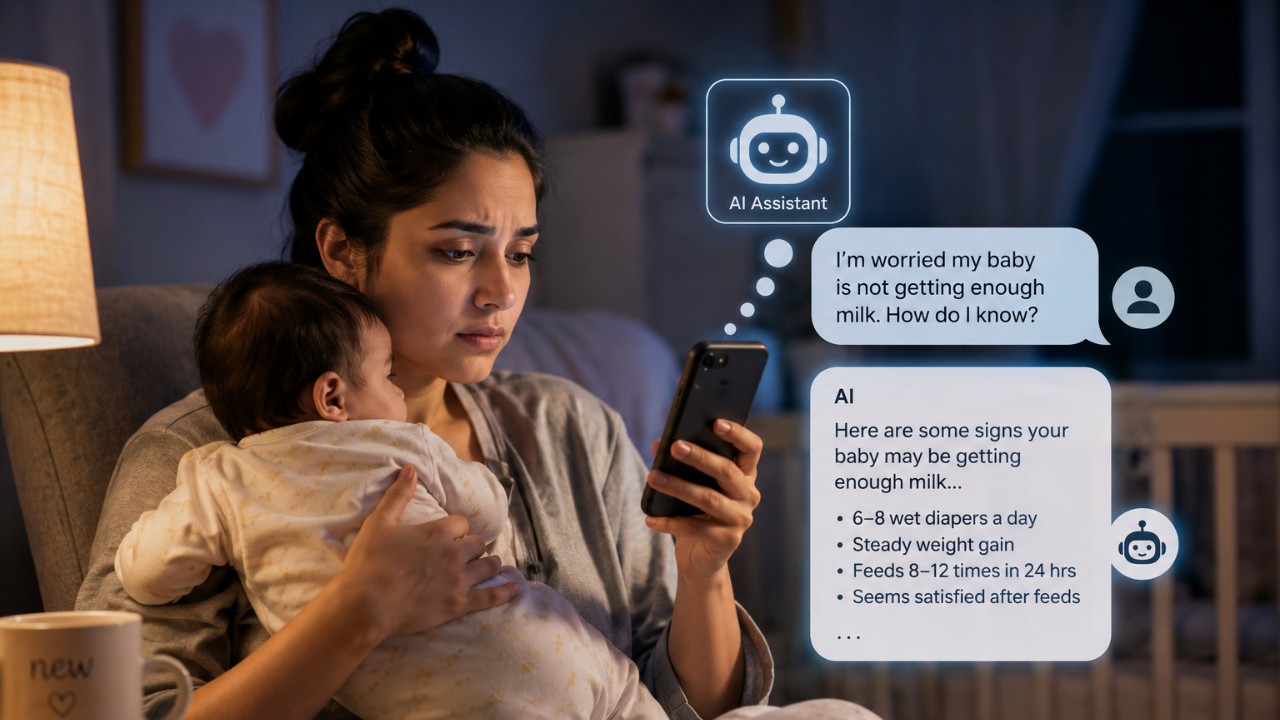
For new mothers struggling with breastfeeding, artificial intelligence can offer something doctors often cannot: an answer at 2 am.But a new report is raising concerns about what happens when those instant responses replace professional medical advice.A national survey commissioned by Orlando Health found that 51% of women aged 18 to 44 would first turn to an AI chatbot, social media platform or search engine if they had an urgent breastfeeding question. Only 29% said they would first contact a doctor or lactation consultant, while 21% would turn to family or friends.The findings highlight a growing challenge as new parents increasingly use AI to navigate pregnancy, caring for their infants and breastfeeding.Is AI Advice Always Reliable? AI can quickly explain clinical terms, suggest possible causes for a problem and provide general breastfeeding information. But it cannot examine whether the baby is actually getting enough milk.“There are certain questions that can't be answered by AI,” said Erynne Bowers, M.D., a pediatrician with Orlando Health Physician Associates.Bowers said roughly one-third of mothers who come to her with breastfeeding concerns have already received inaccurate advice from AI. Some of the misinformation involves recommendations about how much milk a baby should consume or how frequently the baby should be fed. The expert says that's where generic advice from AI can become misleading and dangerous.Also read: Could Light-Controlled Nanobots Revolutionise Breast Cancer Treatment? Indian Researchers Explore The PossibilityFeeding Pattern Is Different For Every BabyA baby's nutritional needs depend on several factors, including age, birth weight, growth trajectory, medical history and feeding efficiency.Doctors also examine the baby's weight gain, hydration, urine and stool patterns, alertness and developmental progress. They may observe the baby's latch, tongue movement and coordination between sucking, swallowing and breathing. These assessments cannot be done by an AI chatbot.A baby may spend a long time at the breast but transfer very little milk. Another may feed for a shorter period but feed efficiently. A generic feeding schedule therefore cannot explain the entire problem. Also read: Breastfeeding Can Help Reduce Mothers' Risk of Type 2 Diabetes, Breast Cancer and MoreHow Incorrect Advice Can Create A Cycle? Experts warn that telling a mother to feed less frequently, for example, could potentially reduce the baby's calorie intake while also lowering breast stimulation.Milk production is closely linked to how frequently and effectively milk is expressed. Poor milk transfer can therefore contribute to declining supply, which can then worsen feeding difficulties and inadequate weight gain.The report also describes the experience of Florida mother Emily Hunziker, whose newborn son began losing weight despite her efforts to breastfeed exclusively. She worked with a pediatrician and lactation specialist, used a combination of pumping, bottle-feeding and supplemental formula while continuing to support her breastfeeding goals. Her son is now thriving and growing up well.Also read: Breastfeeding Vs Mixed Feeding: Which Is Right For Your Baby? Experts ExplainShould New Mothers Stop Using AI For Breastfeeding Advice? It does not mean that new mothers should completely stop using AI. AI can be useful for understanding medical terminology, preparing questions for a doctor or finding reliable resources. But it should not become the final decision-maker when an infant's nutrition or growth is at stake.Warning signs like poor weight gain, unusual sleepiness, dehydration, persistent vomiting, breathing difficulties, severe pain or a sudden drop in feeding require medical assessment from a doctor rather than an automated generic advice. Relying excessively on an AI chatbot for answers may delay seeking a physician's help which could, in turn, delay clinical examination and treatment.