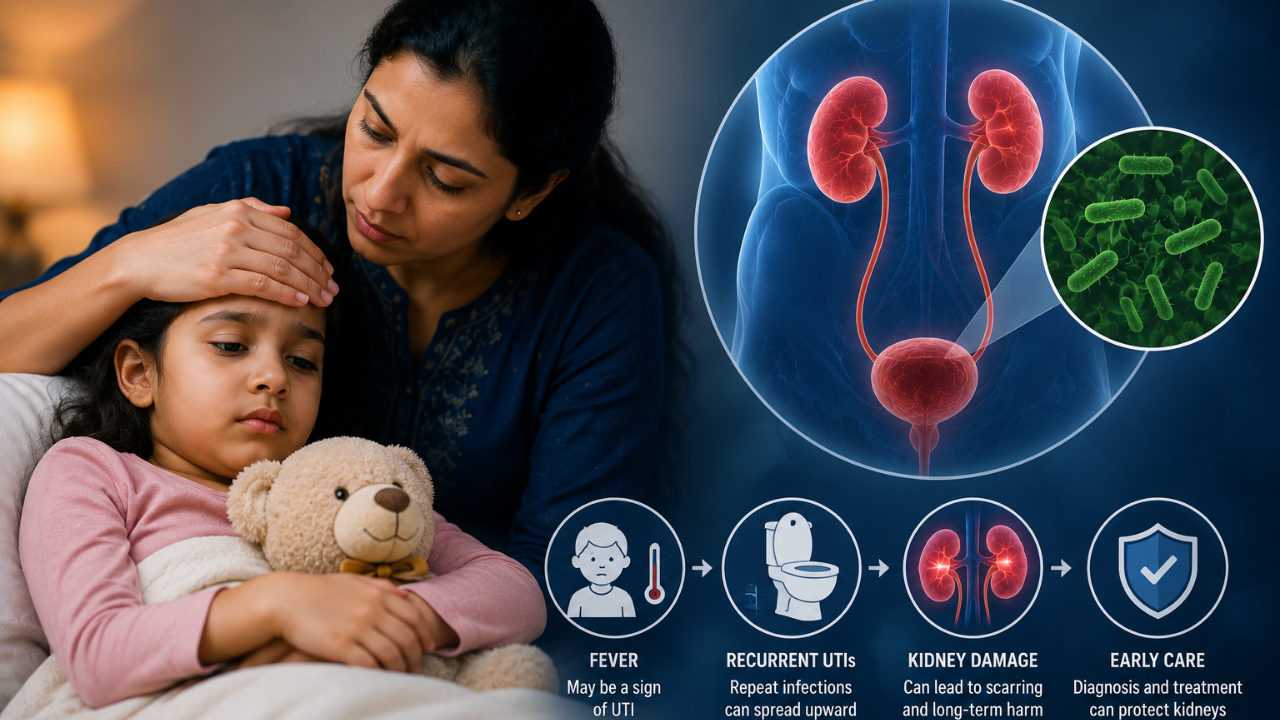
A fever in an infant or young child is often dismissed as a routine infection. However, recurrent or unexplained fever could sometimes point to a urinary tract infection (UTI), which, when associated with an underlying abnormality, may put the kidneys at risk. Identifying UTIs early is particularly important in infants and toddlers who cannot communicate their symptoms. When Fever May Signal a UTI Unlike older children, infants and toddlers cannot explain symptoms such as pain or burning while urinating. A UTI may therefore present only as fever, poor feeding, reduced milk intake or irritability. Whenever a child has a febrile UTI, we should look for an underlying cause. One such condition is vesicoureteral reflux (VUR), where urine flows backwards from the bladder towards the kidneys. How Reflux Can Affect the Kidneys When bacteria are present in the bladder, this backward flow can carry infection towards the kidneys. Repeated kidney infections can cause renal scarring, particularly in young children. Repeated scarring can affect kidney growth and function and, in severe cases, contribute to chronic kidney disease later in life. This makes timely evaluation and management important.Also read: No Washrooms for Women: The Shocking Health Risks of UTI, Hyperuricemia & More Not Every Child Needs Surgery After a documented febrile UTI has been treated, children may require evaluation for an underlying cause based on their age, history and clinical findings. If VUR is identified, treatment depends on its severity. Not every child with reflux needs an operation. Management depends on the grade of reflux and the child’s clinical condition.VUR is graded from 1 to 5. Low-grade reflux, particularly Grades 1 and 2, can often be managed through monitoring and, in selected cases, antibiotic prophylaxis. Many children may outgrow the condition as the urinary system matures. Higher-grade reflux, especially when associated with recurrent infections or renal scarring, may require intervention. Options include minimally invasive Deflux injection or laparoscopic and robotic-assisted surgery in selected cases.Also read: AIIMS Performs Second Dual Kidney Transplant Using Organs From 70-Year-Old Donor: How It Can Expand Donor Pool? Prevention Goes Beyond Antibiotics Constipation, bowel and bladder dysfunction, and improper toilet habits, which can contribute to recurrent UTIs, should also be given attention. Encouraging children to void regularly and managing constipation can help reduce infections. In the present era, urinary abnormalities may be suspected during an antenatal ultrasound (TIFFA scan) allowing early postnatal evaluation and monitoring. Early Detection Can Protect Kidney Health The message for parents is simple: recurrent fever in a young child should not always be dismissed as a routine infection. Identifying a UTI and investigating an underlying problem such as VUR at the right time can help prevent recurrent infections, reduce renal scarring and protect kidney health in the long run.By Dr. G. Ravindra Varma, Managing Director and Senior Consultant Urologist, Andrologist, Uro-Oncologist, Laparoscopic and Robotic Surgeon, AINU, Visakhapatnam