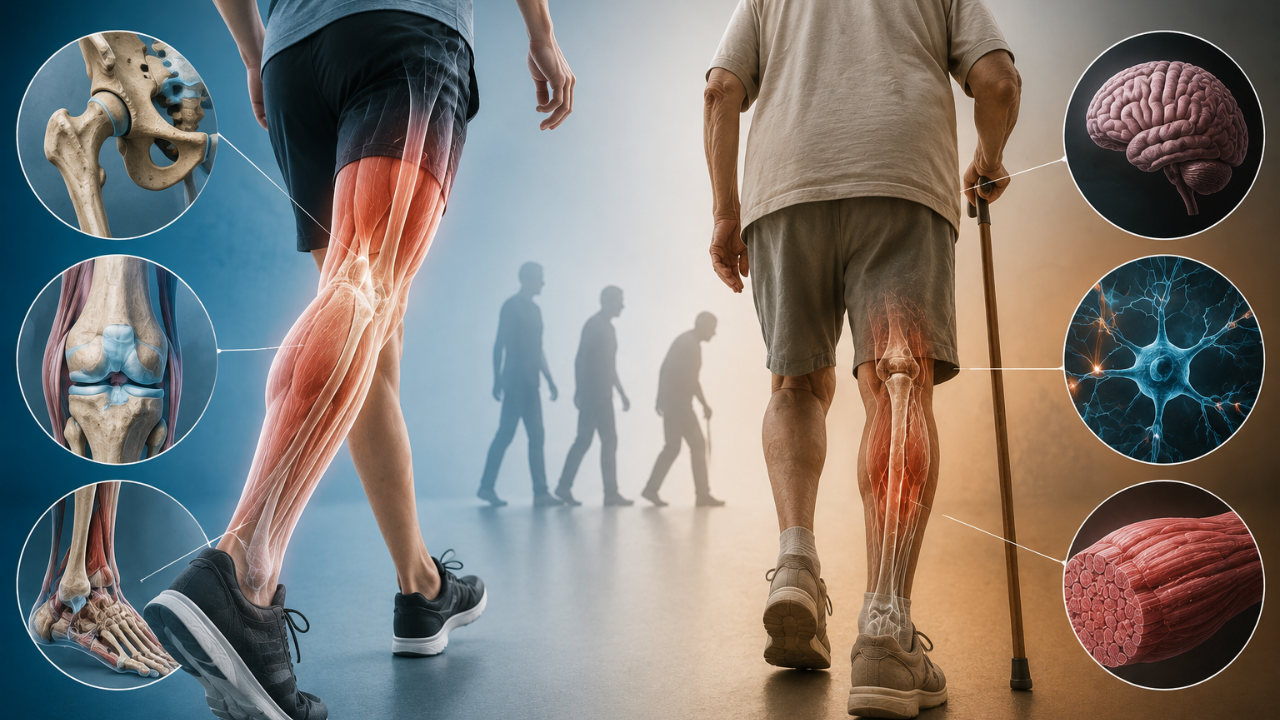
Walking may feel slower, harder and more tiring as we get older, but scientists say the reason could be more than simply losing muscle strength.New research has found that ageing changes the way the ankle and surrounding muscles work during every step, causing the body to prioritise stability over walking efficiency. It may help older adults stay upright, but it also means walking requires more effort and produces less forward movement. The study, led by researchers from Flinders University and the University of Canberra, analysed movement data from 107 healthy adults aged 26 to 86. The findings were published in Gait & Posture. What Changes In The Body as You Age?One of the key changes that happens in the body as we age are around the ankles. Researchers found that older adults are more likely to activate opposing muscles around the ankle at the same time, a phenomenon called co-contraction. This makes the ankle joint stiffer when the foot hits the ground.That stiffness can provide greater stability, essentially helping the body feel more secure with every step. But it could have an adverse effect. “As we get older, the body starts to favor stability over efficiency,” said lead author Dr Cody Lindsay, a sport and exercise technology expert at Flinders University. “That helps keep us upright, but it also makes walking more of an effort.”Also read: What Is Zone 2 Cardio? The Workout Everyone Is Talking AboutWalking Become Slower As We AgeThe researchers also found that older participants generated less push-off power with each step. The push-off phase is the moment your foot pushes against the ground to propel your body forward. When that push becomes weaker, the body travels less distance with each stride. This results in shorter steps, slower walking speeds and more fatigue.The nervous system appears to be partly responsible for this change. Rather than maximising speed and energy efficiency, it adopts what researchers describe as a “safety-first” strategy that favours stability and control.Associate Professor Maarten Immink, co-author of the study, said this may also make it harder for older adults to recover from trips or slips, potentially increasing the risk of falls.Also read: One Bad Landing Can Change Everything: Avoid These Common Knee Injury MistakesThe findings help explain why an older person may feel increasingly tired after walking a distance that once felt easy.It may not simply be that their muscles have become weaker. The entire movement strategy changes as we age.The body is effectively spending more muscular effort to maintain stability while getting less forward movement from each step. It reveals an important biological behaviour that surfaces due to aging. This can also affect confidence and independence. Researchers say people may notice that they tire more quickly or feel less steady, especially while when walking on uneven surfaces. Exercise May Help The researchers say maintaining mobility may require more than traditional strength training. Exercises that challenge balance, coordination and lower-leg strength could help the body maintain better movement control as it ages.Dr Lindsay recommends regular physical activity, balance exercises such as tai chi, lower-leg strengthening and activities that challenge coordination. “Staying active is one of the most important things people can do,” he said, adding that consistent exercise could help people remain mobile and independent for longer.