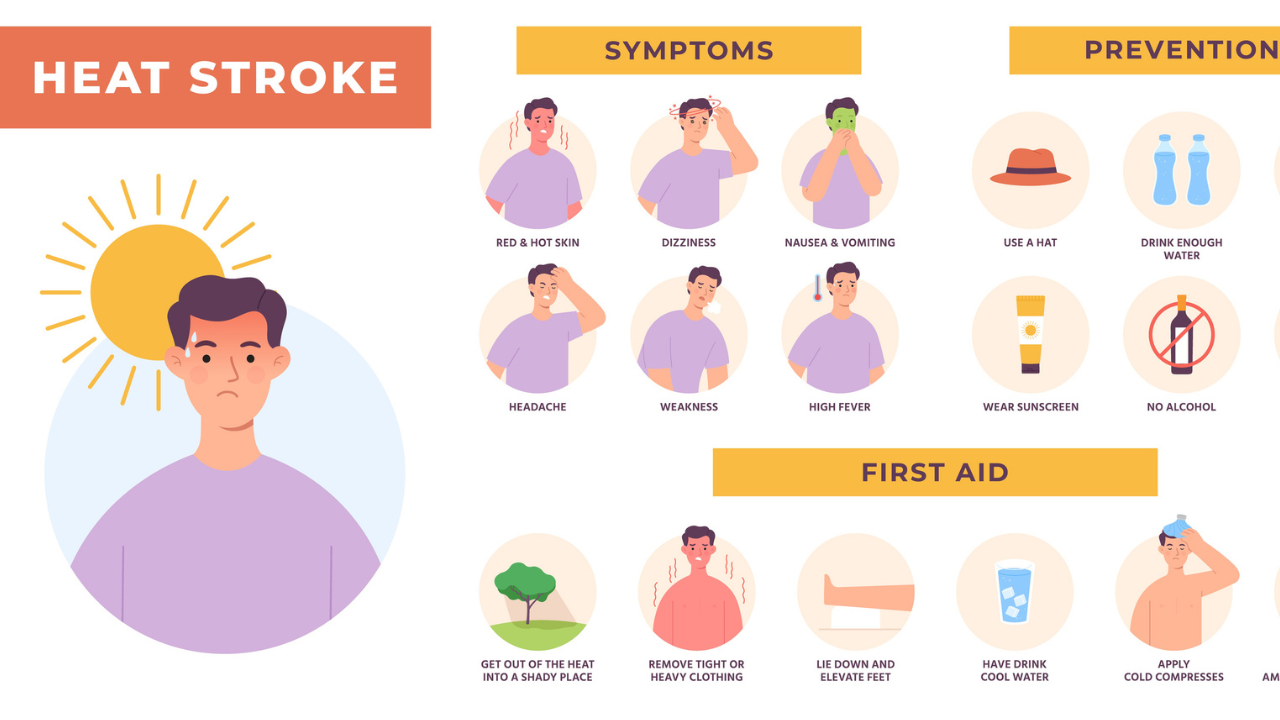
A 24-year-old student from West Bengal has reportedly become the first confirmed heatstroke case of the season in India’s national capital.According to doctors at Dr Ram Manohar Lohia (RML) Hospital, the young man was admitted in critical condition after developing hyperpyrexia — an extremely high body temperature, and altered mental status while travelling by train to the national capital."We received our first heatstroke patient at the RML Hospital on the intervening night of May 20-21. The 24-year-old youth from West Bengal was travelling on a train when his health deteriorated,” said Dr Ajay Chauhan, Director Professor of Medicine, at RML, PTI reported.“He was brought to the hospital in an unconscious state. We took immediate action and tried to cool down his body,” he said, adding that the boy "is admitted to the medicine ward and is still critical".As per the doctors, the student had no known pre-existing medical condition, and other possible causes of his symptoms were ruled out before heatstroke was diagnosed.What Is Heatstroke?Heatstroke is the most severe form of heat-related illness and is considered a medical emergency. It occurs when the body loses its ability to regulate temperature due to prolonged exposure to extreme heat or dehydration. In most cases, body temperature rises above 104°F (40°C), which can damage the brain, heart, kidneys, and muscles.“The general features of a patient with heat stroke are: first, his or her body temperature will be very high. It will not be around normal levels like 104, 105, or 106—it will be significantly elevated. Second, the person may be delirious, confused, or even in a state of unconsciousness or coma. The breathing will also be labored,” Dr. Naval Vikram, Professor, Department of Medicine, at the AII India Institute of Medical Sciences (AIIMS), told HealthandMe.During a heatwave, most patients improve quickly with rest, oral fluids, cooling measures, and moving to a shaded or air-conditioned environment."However, if heat exposure continues and the body’s cooling mechanisms begin to fail, the condition can progress to heat stroke, which is a medical emergency. In heat stroke, body temperature often rises above 104°F," Dr. Vaibhav Mishra, Senior Director & Head, CTVS, Max Super Speciality Hospital, told HealthandMe.What may initially appear as confusion, disorientation, or irrelevant talking can rapidly worsen into:altered consciousness,seizures,coma,death.Heat Stroke: How Can One Prevent?Also read: Bundibugyo Ebola Cases Rise To 600 As Scientists Investigate Spillover EventWhile it may be impossible to avoid rising temperatures, the focus should be on how much you can protect yourself. Experts suggest the following measures:Avoiding exposure to extreme heat as much as possible.In case of being exposed, make sure to cover yourself—cover your head and upper body, use an umbrella, stay hydrated, and take breaks in between.If you have to work in a hot environment for a couple of hours, take a break in a cooler or temperature-controlled environment for at least half an hour before resuming, rather than continuously working in the heat. These steps can help prevent heat-related problems.If symptoms do occur, and it is heat exhaustion, take rest and avoid further activity for some time.In more severe cases—if someone shows symptoms like loss of consciousness or very high body temperature—they should be taken to a hospital immediately. Do not try to manage such cases at home.What Does the IMD Say? The India Meteorological Department (IMD) has warned of severe temperatures across several states."Heat wave to severe heat wave conditions likely to continue to prevail over northwest & central India during the week and over East India during the next 5 days," the IMD said, in its latest update on May 20.It added that severe heat conditions will persist for at least the next 72 hours across Delhi-NCR, Rajasthan, Uttar Pradesh, Punjab, and Haryana. Temperatures in several cities are expected to touch 47°C to 48°C, with Banda currently emerging as the hottest place in the country.