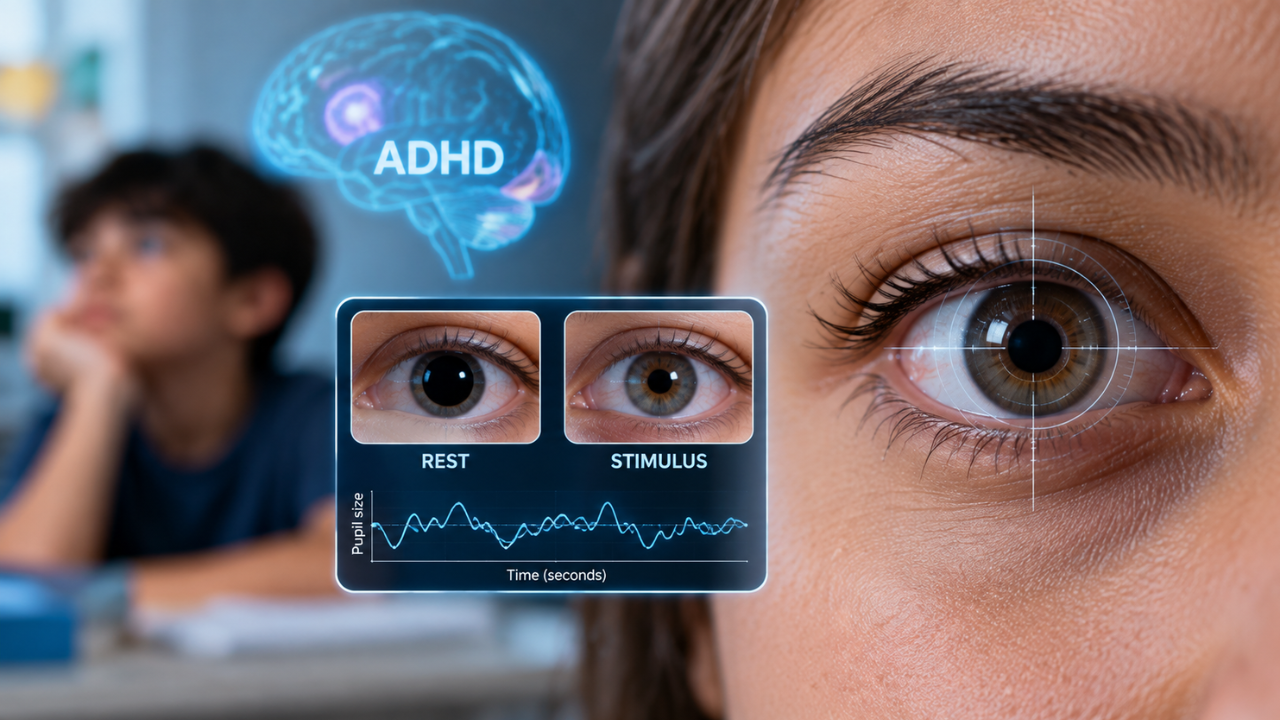
Your eyes may explain a lot about how your brain handles attention. A new Indian study suggests that tiny fluctuations in the pupils may provide a physiological clue to attention related differences in children with ADHD. Researchers from the Indraprastha Institute of Information Technology Delhi analysed eye-tracking data from 50 children aged 10 to 12, including 28 children with combined-type ADHD and 22 without a neurodevelopmental diagnosis. These findings were published in Scientific Reports. Instead of just looking at the size of the pupils, researchers examined how pupil responses shifted from one trial to another while children performed a working-memory task. What ADHD-Related Clues Do Pupils Hold?During the experiment, children watched dots appear on a grid and had to remember their positions while ignoring distractions. An eye tracker recorded their pupil diameter 1,000 times per second. After accounting for age, IQ and memory-task difficulty, the researchers estimated that unmedicated children with ADHD had about 23% greater trial-to-trial variability in their pupil responses than children in the control group. Among the unmedicated children with ADHD, greater pupil variability was also associated with poorer accuracy on the task. The pattern was, however, more complicated. Within individual trials, pupil variability was actually lower in the ADHD group. This suggests that different measures of pupil dynamics may capture different aspects of attention and brain activity.Also read: Increased Screen Timings Have Lead to ADHD: Key SymptomsEffect Of ADHD Medication On The PatternThe researchers also looked at 17 children with ADHD who completed the task both after taking their usual methylphenidate medication and after stopping it for 24 hours. When the children were taking medication, their pupils showed a stronger response during the task and less variation between trials. Their overall pupil-response pattern also became more similar to that of the control group. But the researchers caution against interpreting this as proof that medication normalising attention span. Methylphenidate can itself influence physiological systems that affect pupil size, meaning the study could not completely separate the drug's direct effects on the pupils from changes related to attention.Also read: Using AI Apps To Manage ADHD? How They Can Help And Why Experts Urge Caution Can A Pupil Test Diagnose ADHD? There is no single biological test for ADHD currently. Diagnosis involves clinical assessment, developmental history and behavioural symptoms across different settings and circumstances. The study itself has several limitations. For instance, it was based on a small sample, used existing eye-tracking data and involved a controlled laboratory task rather than everyday environments like classrooms. Although the statistical model found greater trial-to-trial pupil variability, the direct participant-level difference between the ADHD and control groups did not remain statistically significant after correction for multiple comparisons. The researchers therefore describe pupil dynamics as a useful source of additional physiological information, rather than a diagnostic test. First author Saumya Yadav said, "It is still too early to consider pupil measurements as a clinical diagnostic tool.” Larger studies will need to determine whether these pupil patterns can reliably distinguish ADHD from other conditions and whether they remain consistent outside laboratory settings.