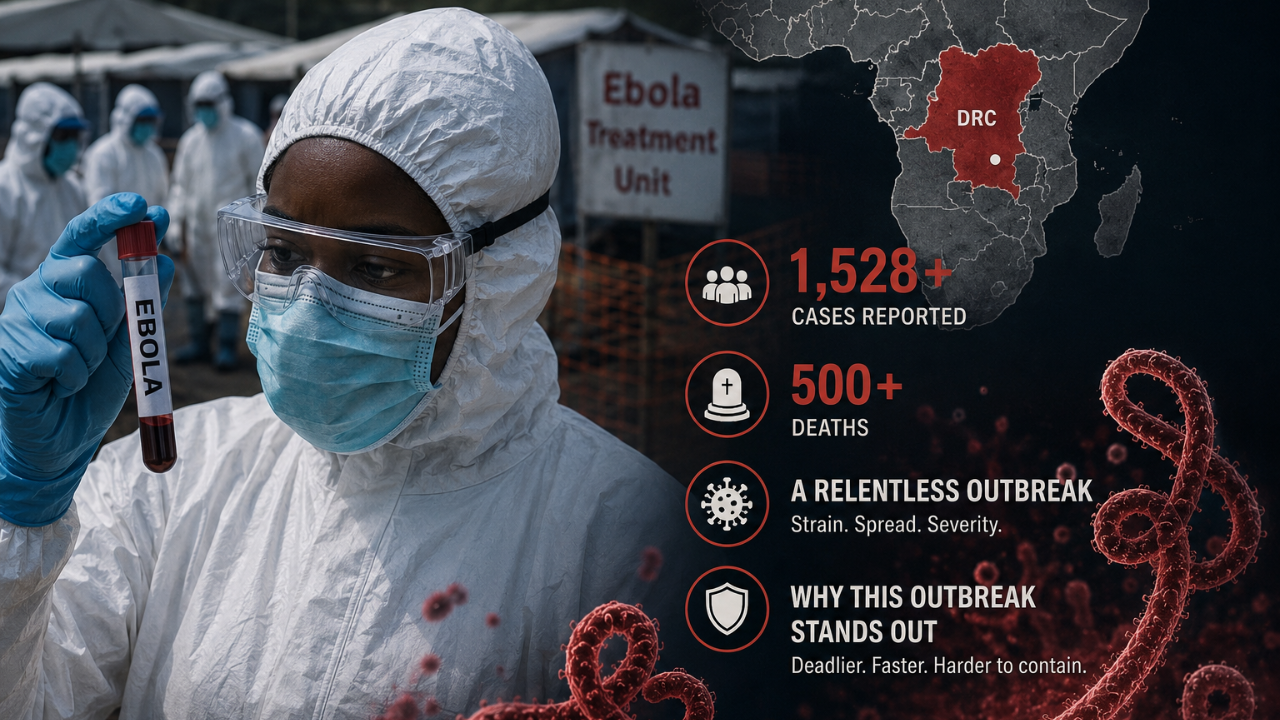
The Democratic Republic of the Congo (DRC) is battling one of its deadliest Ebola outbreaks in recent years. While it is driving innovation in medical science with new clinical trials and diagnostic tests, it is also a stark reminder of the urgency to contain the outbreak as soon as possible. What Makes This Ebola Outbreak Deadlier? According to the latest data, the death toll in DRC has now crossed 500 with at least 1,528 cases that are reported and confirmed. While Ebola is not a new disease, the current outbreak stands apart because it is being caused by a rare strain of the virus, Bundibugyo. Unlike previous outbreaks dominated by the Zaire strain of Ebola, the current epidemic, caused by the Bundibugyo virus, is a much less common species of the Ebola virus family. The rarity of the strain has created unique scientific and emergency public health challenges, as there is currently no licensed vaccine designed to protect against Bundibugyo Ebola virus. During outbreaks caused by the Zaire strain, vaccination became an important part of outbreak control. In the current epidemic, however, public health officials are being forced to rely heavily on rapid diagnosis, infection prevention, surveillance, and existing medical care.Read more: Legionnaires' Disease Outbreak Grips NYC After At Least 14 Cases Reported Across 2 Neighborhoods Bundibugyo Ebola Virus: Latest Developments WHO Clears First Diagnostic Test In a major scientific breakthrough, the World Health Organization (WHO) recently added the first molecular diagnostic test for the Bundibugyo Ebola virus to its Emergency Use Listing (EUL). The test detects the virus's genetic material in blood samples, enabling laboratories to confirm infections more quickly and accurately. First Treatment Trial Underway WHO and its partners have launched the first clinical trial specifically evaluating treatments for Bundibugyo Ebola virus disease. Researchers are testing the experimental monoclonal antibody MBP134, the antiviral drug remdesivir, and a combination of both to determine whether they can improve survival. About Bundibugyo Ebola Virus The Bundibugyo virus was first identified in Uganda in 2007 and has caused only a few outbreaks since then. As infections have been relatively uncommon compared to the Zaire strain, researchers have had limited opportunities to develop vaccines, treatments and diagnostic tests. Due to this, healthcare workers have been compelled to rely primarily on rapid isolation of patients, intensive supportive care, contact tracing, and strict infection prevention measures to slow transmission. Currently, Eastern DRC is the hotspot for the Bundibugyo Ebola outbreak, where conflict, population displacement, skepticism, and insecurity have made it difficult for health workers to reach affected locations. Here, access to healthcare still remains uneven in many areas. Additionally, movement of people across districts and states in the country can accelerate the spread of infection significantly. As scientists race to validate new diagnostics and evaluate experimental treatments, the Bundibugyo outbreak is becoming more than a public health emergency. It is also serving as a critical test of how quickly the global health community can develop and deploy new tools against an emerging infectious disease.