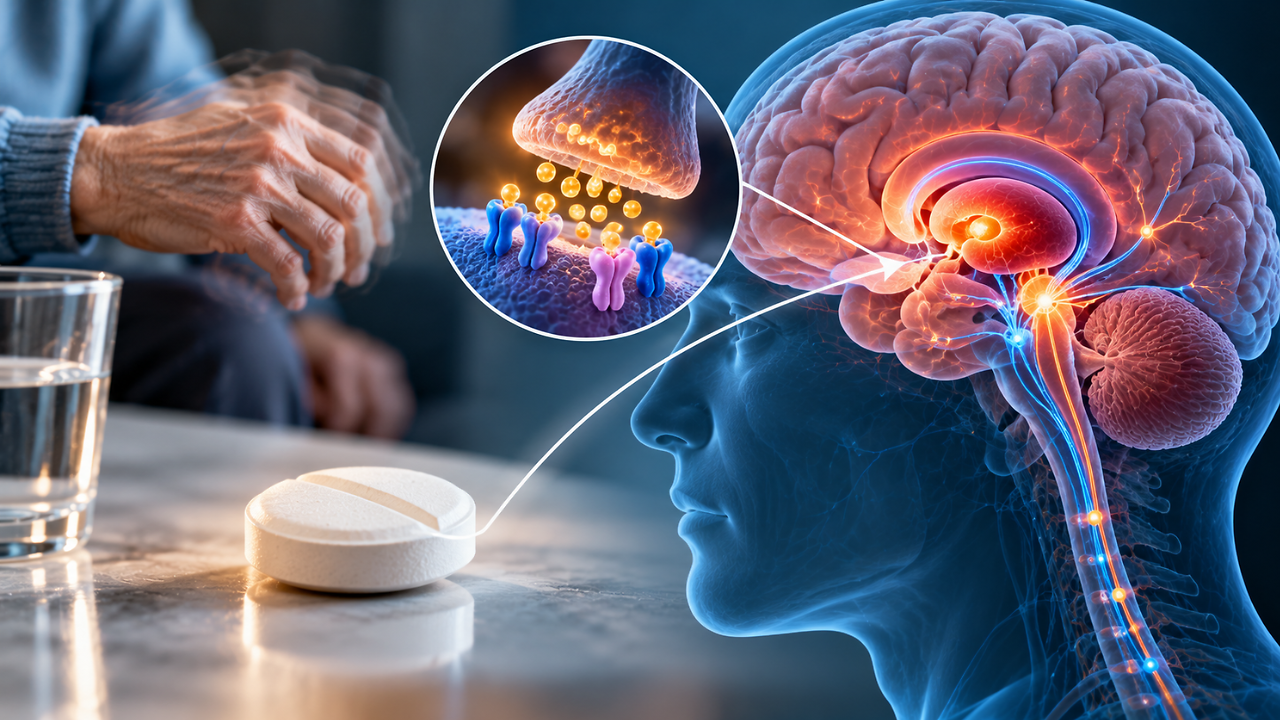
The US Food and Drug Administration has approved tavapadon, a once-daily oral medicine for adults with Parkinson’s disease. This has added a new option to Parkinson's treatment strategy that has long relied on drugs that mimic the brain’s dopamine supply. The drug will be sold in the US under the brand name Juvmo. Tavapadon is different from traditional dopamine agonists because it selectively targets D1 and D5 dopamine receptors. It has been studied both as an early treatment and alongside levodopa in people with more advanced Parkinson’s disease and motor fluctuations. Parkinson’s Disease & Dopamine Parkinson’s disease is a progressive neurological disorder in which dopamine-producing nerve cells in a region of the brain called the substantia nigra disappear gradually. Dopamine is essential for controlling movement. As its levels fall, people can develop symptoms like tremor, stiffness, slowness of movement and problems with balance. This is why many Parkinson’s treatments entail increasing dopamine levels or mimicking its effects in the brain. How Does Tavapadon Work? Also read: Parkinson’s Is Rising Across US, But Not Equally: Why Are Some States Seeing More Cases Than Others?Tavapadon is a selective D1/D5 partial dopamine agonist. It means that it does not simply increase the amount of dopamine in the brain. Instead, it binds to particular dopamine receptors and partially activates them, essentially helping reproduce some of dopamine’s signalling effects. Most currently available dopamine agonists target D2/D3 receptors. Tavapadon’s D1/D5 is therefore one of its distinguishing characteristics. Researchers have been investigating whether this drug can can help provide motor symptom relief while avoiding some adverse effects linked with dopamine receptor activation.The FDA’s approval was supported by the phase 3 TEMPO clinical programme. In TEMPO-1, which involved 529 people with early Parkinson’s disease, both 5 mg and 15 mg daily doses of tavapadon significantly improved motor function compared to placebo after 26 weeks. The drug has also been studied in people already taking levodopa who experience motor fluctuations, a common problem with progressive Parkinson’s. In the TEMPO-3 trial involving 507 participants, adding tavapadon to levodopa increased daily 'on' time without troublesome dyskinesia compared to placebo.As Parkinson’s disease progresses, some people taking levodopa experience periods when the medicine is working well and movement improves. This is called 'on' time. When the medication’s effect wears off and Parkinson’s symptoms return, it is called 'off' time. Treatment aims to increase 'on' time while limiting troublesome involuntary movements, known as dyskinesia. Side Effects Of Tavapadon? Tavapadon was generally tolerated in the clinical trials, but it is not free of side effects. In the TEMPO-1 trial, the most commonly reported adverse events were: NauseaHeadacheDizzinessThe FDA’s approval follows data showing improvement in Parkinson’s symptoms, but longer-term safety remains an important factor that needs more investigation. Dopamine agonists can also be associated with sleepiness, low blood pressure on standing, hallucinations and impulse-control disorders. These issues remain relevant when doctors consider where tavapadon fits into an individual’s treatment plan.Tavapadon treats the symptoms of Parkinson’s disease. It does not restore the dopamine-producing nerve cells that have been lost or stop the neurodegenerative process.