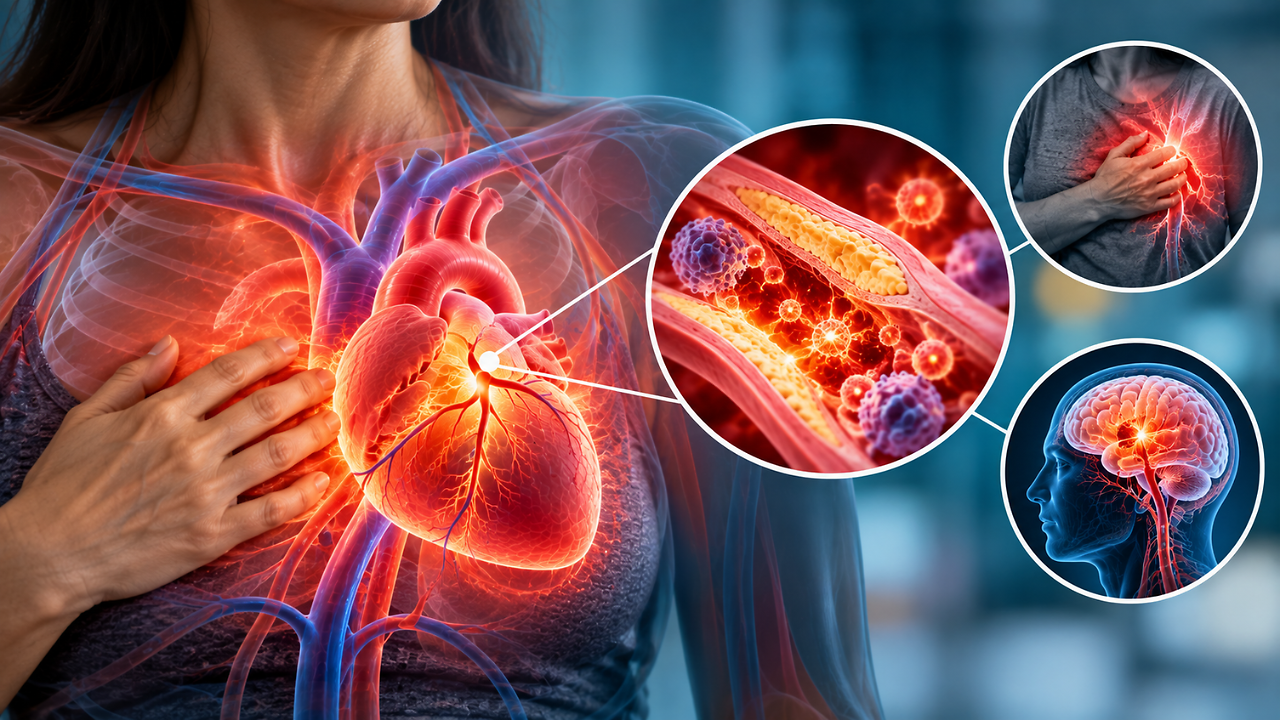
You can feel fine and still have a heart that is slowly changing. Researchers at Imperial College London and the MRC Laboratory of Medical Sciences say millions of people could be living with hidden inflammation that does exactly that. They say the changes can start years before any symptoms show up."Our study, which is the largest of its kind, suggests that millions of people could be living with hidden inflammation, which is slowly changing their heart and causing long-term damage," said Professor Declan O'Regan, British Heart Foundation Chair of Cardiovascular AI at Imperial College London. What The Study FoundThe study was published in the European Journal of Preventive Cardiology. The team looked at data from nearly 480,000 adults in the UK Biobank, a large health database, Imperial says. They measured a blood marker called glycoprotein acetyls, or GlycA for short, which the paper uses to measure chronic inflammation. They also used heart scans and genetic data. People with the highest levels of inflammation, the top 20%, had a 43% higher risk of heart attack and stroke than those with the lowest levels, the bottom 20%, according to Imperial. Imperial adds that higher levels also went with changes in the heart itself. These included thicker heart walls, smaller heart chambers and poorer filling of the heart. The researchers say such changes can build quietly for years before possibly leading to heart failure.Read More: Childhood Vaccine Rates Decline Across Europe, Lancet Study Finds Where The Inflammation Comes FromChronic inflammation is a long-term, low-level activation of the immune system, Imperial explains. It has been linked to cancer and diabetes, and is increasingly seen as a driver of heart disease.According to Imperial, higher inflammation was strongly linked to poorer social and economic circumstances and to mental distress, as well as to smoking and excess body fat. "The surprising thing was how much social factors and mental health are linked to inflammation and damage to the heart, as well as more well-known risk factors like smoking and inactivity," O'Regan said. He added that there was also a strong genetic factor, "with some people being naturally more resilient or susceptible to the inflammatory damage that comes from different lifestyles." What Could Come NextThe study named proteins from the interleukin-1 and TNF families as likely drivers of the damage, Imperial says. Several are already targeted by drugs in clinical trials, which Imperial says raises hopes that anti-inflammatory treatments could help prevent heart disease before symptoms begin. The researchers say combining inflammation blood tests with genetic risk scores could help find the people who would benefit most from early action. There is earlier proof that this idea can work. In the 2017 Canakinumab Anti-inflammatory Thrombosis Outcomes Study, or CANTOS trial for short, led by Paul Ridker and published in the New England Journal of Medicine, 10,061 people who had already had a heart attack, and had high inflammation, were given canakinumab or a placebo. The paper concluded that at the 150 mg dose, given every three months, canakinumab led to fewer repeat cardiovascular events than the placebo, independent of any drop in cholesterol. But those were heart attack survivors, not people without symptoms. What to keep in mindThe study reports links, and the researchers describe inflammation as one possible pathway to heart damage. They also stress that being genetically susceptible, or living in hard circumstances, does not mean a person will develop heart disease, and that much can be done to prevent long-term inflammation.