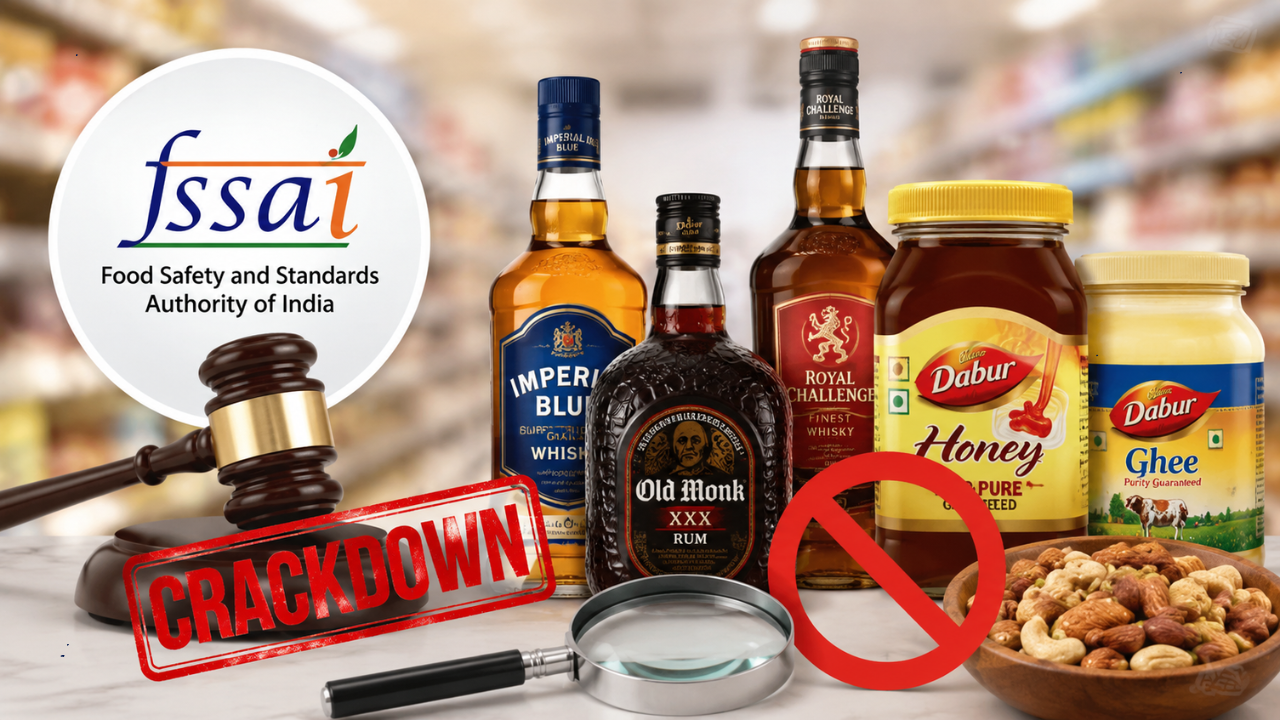
The Food Safety and Standards Authority of India (FSSAI) has stepped up enforcement across the food, beverage and FMCG sectors, with the drive gathering pace since July.In recent weeks, FSSAI has acted against or scrutinised products and companies over misleading claims, hygiene and food-safety violations, non-compliant ingredients, labelling issues and failure to meet prescribed standards.The action has covered packaged foods, liquor, edible oils, sweeteners and high-caffeine beverages.What Has FSSAI Cracked Down On? 1. Dabur — “100%” ClaimsFSSAI directed Dabur India to prohibit the sale of food products such as honey, cow ghee and edible oils carrying “100%” claims.Dabur challenged the action, accusing FSSAI of favouring certain manufacturers. The company approached the Delhi High Court, which stayed the order, with Dabur arguing that the action was taken without allowing it to be heard.Dabur also submitted that the “100%” claim is used by several other manufacturers. The matter will next be heard by the Delhi High Court on August 24.2. Liquor Brands — Artificial FlavouringThe food safety regulator has banned the sale of select whisky and rum products from major liquor companies, including Diageo India’s United Spirits, after finding artificial or “nature-identical” flavouring that allegedly violates Indian food standards.The affected products include United Spirits’ Antiquity Blue Whisky and Royal Challenge Whisky manufactured in Madhya Pradesh, Inbrew’s Bagpiper Deluxe Whisky and Old Cask Deluxe XXX Rum, and three variants of Old Monk produced by Mohan Rocky Springwater in Maharashtra.3. VKC Nuts — licence suspendedThe licence was suspended following serious food-safety and hygiene violations, including live insects in pistachios stored in the finished goods storage area, and heavy black mould and fungal growth observed on the walls and ceilings of the raw material storage area.4. Chheda Specialities Foods — licence suspendedThe Mumbai-based ethnic snack and namkeen manufacturer faced licence suspension over serious hygiene violations. Inspections reportedly found unhygienic handling, roof leakages, fungal growth near edible oil storage tanks and poor waste management.5. Fortune Fryola — Vitamin D standardsAction was taken against AWL Agri Business after its fortified sunflower oil failed prescribed Vitamin D standards. 6. PIE Foods — monk fruit sweetenerAction involved related compliance issues. FSSAI also flagged product labels that lacked mandatory declarations and carried claims including “100% Monk Fruit Extract” and “Natural Ingredients”. Its e-commerce website also carried the claim “Doctor Recommended”.7. High-caffeine beverages — “energy drink” claimsFSSAI has continued action over products using the term “energy drink” without meeting relevant standards. Brands involved include Red Bull, Monster, Sting and Adrenaline Rush.Other Recent ActionsSwitz Foods: Licence suspended over food-safety and hygiene violations.Matri Drinking Water: Licence suspended over food-safety, storage and hygiene issues.Noble Healthcare – Venolex Forte: Action over non-permitted ingredients and excessive Vitamin C.Vatave Healthcare – Folineuro Syrup: Action over brain-function claims.Global Healthfit Retail – Neuherbs True Vitamin: Action over product naming and claim-related compliance.Why Does the Crackdown Matter?Stronger enforcement could improve food quality, curb misleading claims and encourage manufacturers to comply with safety standards, experts say.“Although late, this initiative of enforcement of correct ingredients of the products is very beneficial in the long-term health of the nation, especially the youth health, those who consume more of the packed items including beverages, canned food and drinks, fruit drinks and packed milk,” said Dr Mohsin Wali, Senior Consultant, Department of Medicine, Sir Ganga Ram Hospital, told HealthandMe.Why Clear Labelling MattersDr Wali said food labels should be properly sized, readable and clearly displayed, with key information prominently placed rather than hidden on the sides or bottom of packaging.He also said ingredients should be clearly identified rather than represented through codes. If an emulsifier is used, for example, the specific emulsifier should be named.According to Dr Wali, stronger enforcement could help prevent diseases including obesity, PCOD, atherosclerosis, heart disease, stroke and hypertension.