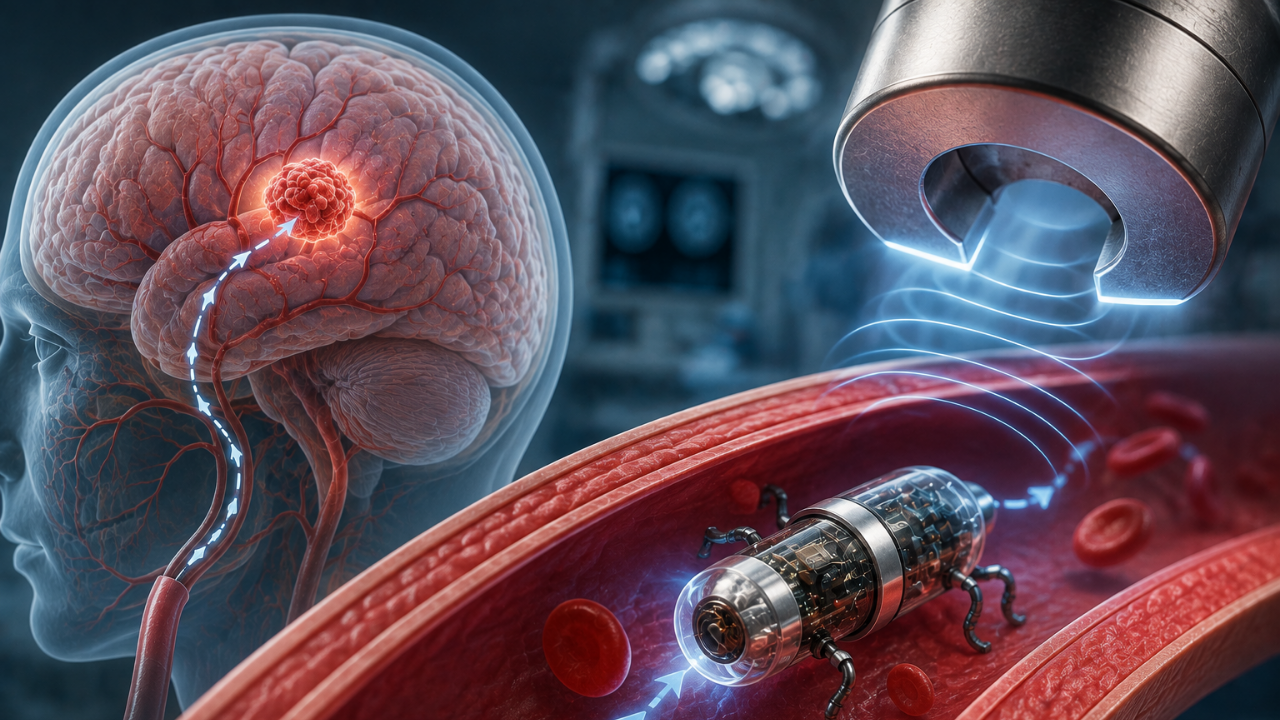
Researchers in the Netherlands are exploring a possibility to reach into remote, difficult areas in the brain without an open surgery. They have developed a tiny, screw-shaped robot that can move through brain tissue under the control of a magnet placed outside the body. The method is yet to be tested on humans. They used sheep brain tissue, including a model in which blood was pumped through the brain's vessels to more closely mimic a living brain.In laboratory experiments, the robot successfully travelled through real sheep brain tissue, offering an early glimpse of a less invasive way to reach areas that are difficult to access with conventional surgery.The technology could eventually be useful to treat deep brain tumours, blood clots following stroke and vascular abnormalities.How Does The Tiny Robot Work?Scientists have made the robot in a spiral, screw-like shape. It does not have a conventional motor inside it. Instead, researchers control it using a rotating magnetic field generated outside the body. As the magnet rotates, the robot moves with it. Its screw-shaped body converts that rotation into forward movement, allowing it to drill its way through soft brain tissue.The researchers also created a mathematical model to predict when the robot could lose synchronisation with the magnetic field. Simply making the magnet spin faster does not mean the robot will keep moving faster.“Push a magnetic robot too fast and it simply stops listening to the magnet,” said Ewout Ligtenberg, first author of the study. He added, “We can now predict exactly when that happens, for any tissue, from a single test. That takes out a lot of guesswork when designing robots for the brain.”Also read: Fifth Universal Definition of Myocardial Infarction: What the 3 New Heart Attack Categories Mean Navigating Inside A Brain Is Not Easy One of the biggest challenges of brain surgery is that is that brain tissue is soft, delicate and mechanically complex. The researchers initially tested their robot in gelatin before moving to actual sheep brain tissue. In the sheep tissue, the robot remained synchronised with the magnetic field up to about 1.8 rotations per second when there was no blood flow. But once blood was pumped through the vessels, it fell to below 0.45 rotations per second. In other words, making the conditions that resemble a living brain made the robot harder to control. The robot moved through the brain tissue at around 0.2 millimetres per second. When researchers reversed it, it was able to travel back through the pathway it had already created much faster, at about 2.9 millimetres per second.Also read: New AI Tool Reads ECG In 2 Seconds, Detects Up To 90% Of Heart Valve Disease Cases This May Help With Brain Lesions The technology may have applications in treating brain lesions as some lesions sit deep inside the brain, where reaching them can mean passing through healthy tissue or opening the skull. The researchers are look for a futuristic approach in which the tiny robot could potentially be guided through blood vessels to a location near the target, pass through the artery wall and then travel through brain tissue towards the lesion. The robot has not been used to treat a brain tumour, remove a clot or operate on a person. Despite promising outcome, there are still major questions around safety, navigation, bleeding, tissue damage.