
- Health Conditions A-Z
- Health & Wellness
- Nutrition
- Fitness
- Health News
- Ayurveda
- Videos
- Medicine A-Z
- Parenting
This Everyday Supplement May Quietly Cut Your Alzheimer’s Risk, New Study Suggests

Credits; Canva
New findings suggest that a common supplement might play a role in lowering the risk of Alzheimer’s disease. Researchers have found that a naturally occurring amino acid may help stop the build-up of harmful plaque in the brain. Alzheimer’s remains the leading cause of dementia and often brings changes in memory, communication and behaviour.
Experts believe the condition begins when certain proteins collect in and around brain cells. One of these proteins, amyloid, can form thick deposits that interfere with how the brain functions. Recent work now indicates that a simple oral supplement may help limit amyloid levels.
A Supplement That May Help Protect The Brain
The study, published in Neurochemistry International, showed that arginine, a naturally present amino acid, could reduce the clumping of amyloid and lessen its damaging effects in animal models of Alzheimer’s.
What Is Arginine?
Arginine, sometimes listed as l-arginine, helps the body build proteins and is found in foods such as meat, fish, nuts, seeds and dairy. It is also available in supplement form. Researchers stressed that the doses used in their experiments were specific to the study and do not match the amounts sold in commercial supplements. Professor Yoshitaka Nagai, who led the research, said the results suggest that arginine has the ability to curb this build-up both in lab testing and in living organisms.
Professor Nagai explained that the discovery is especially encouraging because arginine already has a well-established safety record and is relatively affordable. This combination, he noted, makes it a promising candidate for future therapeutic use. Reports from Science Daily highlight that the animals given oral arginine developed fewer amyloid plaques and showed a drop in insoluble Aβ42 in the brain. These mice also performed better in behavioural assessments and showed reduced activity of inflammatory genes linked to the progression of Alzheimer’s.
How Arginine Affected Brain Changes In Mice
The research team believes that these results may help spark new ideas for preventing Alzheimer’s or slowing its progression. Professor Nagai said that the findings could be useful not only for Alzheimer’s but also for other disorders linked to abnormal protein folding. He added that because arginine is low-cost and already considered safe for general use, it could move into clinical testing more quickly than many experimental drugs. Even so, researchers cautioned that more preclinical work and human-based studies are needed before any firm conclusions can be made about recommended doses or long-term impact.
Signs of Alzheimer’s disease
According to the NHS, early Alzheimer’s often begins with noticeable memory problems. A person in the initial stages may show signs such as:
• Forgetting recent events or conversations
• Misplacing belongings
• Struggling to recall names of common places or objects
• Having difficulty finding the right words
• Repeating questions
• Showing weaker judgement or taking longer to make decisions
• Becoming less adaptable or more resistant to changes
Anyone who notices these changes in themselves or a loved one should consider seeking advice from a GP.
COVID Cicada variant: Are Children More At Risk? How To Safeguard?

Credit: iStock
The COVID Cicada variant, currently circulating in 23 countries, is likely to affect children more than the previous variants.
Children have largely escaped severe illness from the SARS-COV-2 virus.
However, the new Cicada variant with around 75 genetic changes in its spike protein is likely to disproportionately affect children, as per an expert, who noted its presence in the UK.
“Some people have done analysis on this, suggesting it may be more prevalent among young children. Children get infections all the time, but this might be something to do with the fact that they have never been exposed to Covid vaccines," Prof Ravindra Gupta, of Cambridge University, who advised the UK government during the pandemic, was quoted as saying to The Mirror.
“So this is something we’re looking at in the lab to try and work out why. The problem with this is that it is an infection that spreads fast. Eventually, it ends up in someone vulnerable," he added.
Key Symptoms
Symptoms seem to be similar to those of other recent variants and include
- sore throat,
- cough,
- congestion,
- fatigue,
- headache
- fever.
Also read: Cicada Variant: Will The Current COVID Vaccine Provide Protection?
What Do The 75 Genetic Changes Mean?
Cicada, a descendant of the Omicron variant that emerged in 2021, was first detected in South Africa in 2024. However, it disappeared soon after, only to emerge early this year.
Prof Gupta told the publication that “the Cicada variant developed the 75 mutations to escape immunity, and it evolved by incubating a single patient for over a year”.
"This 'patient zero' would have been unable to clear the virus due to a compromised immune system," due to HIV or anti-cancer drugs.
Further, he explained that due to 75 mutations to the spike protein, the body’s antibodies will take a longer time to fight the Cicada variant.
However, there is no evidence yet that it is likely to cause more severe disease.
Will The Cicada Variant Cause Severe Illness?
The Cicada variant is particularly concerning as it provides no immune protection to people with previous infection or even vaccination.
Yet, the World Health Organization and health experts advise that existing COVID vaccinations can help prevent severe illness and hospitalization.
"It would appear that all the protections we have from our experience with the virus and with vaccines probably offer more limited—not zero—but more limited protection against this strain," Dr. William Schaffner, professor of infectious diseases at Vanderbilt University Medical Center, was quoted as saying by Time.
Also read: COVID Variant BA.3.2 Spreads To 23 Countries: Is The Variant Under Monitoring A Cause Of Worry?
How To Safeguard
Dr. Sai Balasubramanian, a doctor and healthcare strategy executive, writing in Forbes, stressed the need to follow COVID practices such as masks and hand hygiene.
"Healthcare professionals recommend taking general precautions, similar to those used to prevent most viral transmission: get vaccinations when appropriate, wear masks in crowded areas or indoors where there is a high risk of transmission," he said.
He also urged “avoid individuals who have known illness or infections, wash hands frequently, and continue to stay apprised of local community guidelines and the infection spread”.
India To Strictly Inspect GLP-1 Drugs To Curb Misuse: Govt Flags Risks Amid Weight-loss Hype

Credit: iStock
GLP-1 drugs are powerful tools that can improve health, but it comes with risks and caveats. While these are medical therapies, they are being misused as cosmetic products by cosmetologists, physiotherapists, dermatologists, among others.
To curb its misuse and improve public health, the Indian government today issued guidelines on its use, while also flagging risks around it.
In an official statement issued today, the government has stated that it will roll out stricter inspections to curb the misuse of GLP-1 drugs in the country and will punish those who violate the rules.
“GLP-1 drugs are a significant medical breakthrough in treating type 2 diabetes and obesity, but they are not without risk. The drugs carry a wide range of side effects - from common symptoms like nausea and vomiting to severe complications including pancreatitis, kidney injury, and bowel obstruction. These risks make it essential that GLP-1 drugs are only taken under the supervision of registered medical practitioners/specialists,” the statement said.
In the wake of its hype over weight loss, the country's regulatory authorities have taken firm steps to prevent unsupervised use and malpractices in the supply chain.
It has “strongly advised” patients and the public to” consult a qualified medical specialist before use, and to obtain these medications with prescription only through legitimate, regulated channels”.
“Stricter inspections and surveillance will continue in the coming weeks. Businesses that break the rules will face license cancellation, fines, and legal action,” the statement said.
Also read: GLP-1 Drugs: Why India Needs Stricter Rules Now
What Are The Side-effects Of GLP-1 Drugs?
GLP-1 drugs work to keep food in the digestive system for longer – making people feel fuller for longer, thus reducing appetite and inducing weight loss. Hence, the drugs are also prescribed to people with obesity.
However, when done without clinical oversight, it can lead to severe health complications.
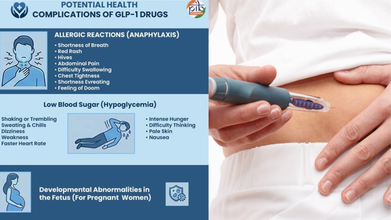
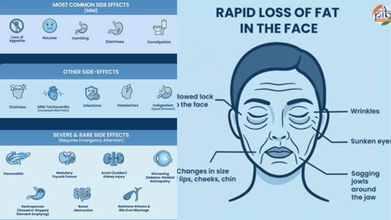
There are various side effects to taking GLP-1 drugs, including nausea and dizziness, to pancreatitis and medullary thyroid cancer.
Some serious side effects include
- Pancreatis
- Thyroid Cancer
- Acute (Sudden) Kidney Injury
- Worsening Diabetes-Related Retinopathy
- Gallstone & Bile Duct Blockage
- Rapid loss of fat in the face
- Wrinkles
- Sunken eyes
GLP-1 medications may also complicate various health conditions, such as allergic reactions, with shortness of breath and low blood sugar.
Rush For Generic Weight Loss Drugs
The government's advisory comes as patent for semaglutide -- an active ingredient in diabetes and anti-obesity drugs, specifically Wegovy and Ozempic -- expired on March 20.
This has led to a rush among Indian pharma companies to launch cheaper generic versions, significantly increasing affordability and access for millions battling Type 2 diabetes and obesity.
Also read: CDSCO threatens action against pharma companies for promoting GLP-1 weight-loss drugs
Major Indian drugmakers who launched their generic semglutide injection in the country in March include Sun Pharmaceutical Industries, Zydus Lifesciences, Alkem Laboratories, and Dr. Reddy’s Laboratories.
WHO Guidelines on GLP-1 drugs
Amid the increasing prevalence of GLP-1 drugs, the World Health Organisation (WHO), late last year, acknowledged its role in treating obesity.
However, it warned that medications like GLP-1 alone will not solve the problem affecting more than one billion people worldwide.
The global health body also issued conditional recommendations for using these therapies as part of a comprehensive approach that includes healthy diets, regular physical activity, and support from health professionals.
Ozempic And Wegovy Prices Slashed Again In India To Counter Cheaper Generics
Credit: iStock
Danish pharma giant Novo Nordisk has once again reduced the prices of its blockbuster drugs Ozempic and Wegovy in India. The strategic move is aimed at staying ahead of the entry of the low-cost generic competition in the country.
Starting today, the Ozempic price in India will be cut by 36 percent, while Wegovy has seen a steeper 48 percent reduction — limiting the base price below Rs 6,000 per month.
While Ozempic is available in three dose strengths of 0.25 mg, 0.5 mg, and 1 mg in India, Wegovy has five dose strengths.
Ozempic's and Wegovy's lowest doses of 0.25 mg will now be priced at Rs 1,415 for a weekly shot from Rs 2,200 and Rs 2,712 earlier, respectively, Novo Nordisk India said in a statement on Tuesday.
The average price reduction across doses is 23.8 percent for Ozempic and 27 percent for Wegovy, it added.
Speaking to the media, Novo Nordisk stated that the price cut will benefit a large section of people with diabetes and obesity in India.
The generic weight loss drugs will open up a huge customer base, especially in India, with a high burden of diabetes and obesity.
Novo first slashed Wegovy's price for the first time by up to 37 percent from its launch price last year.
In addition to the entry of generics, the launch of rival Eli Lilly's blockbuster diabetes and obesity drug Mounjaro in India in 2025.
Also read: Semaglutide Becomes Cheap In India: A Gamechanger Or Health Gamble?
Entry Of Generics In India
Soon after the end of Novo Nordisk's patent on semaglutide, on March 20, a host of companies in India launched generic versions of Ozempic.
This includes NATCO Pharma's Semanat and Semafull, priced at Rs 1,290 per month and Rs 1,750 — about 90 per cent cheaper than Ozempic, costing Rs 8,800 per month.
Eris Lifesciences also announced its plans to launch a multi-dose vial under the brand name Sundae at the same price.
Dr. Reddy’s Laboratories, Sun Pharmaceutical Industries, and Glenmark Pharmaceuticals have also launched their generic versions of semaglutide.
Dr. Reddy’s Obeda is priced at Rs 4,200 per month, available in 2 mg and 4 mg strengths.
Sun Pharmaceutical Industries will sell under the brand names Noveltreat (doses ranging from Rs 900) and Sematrinity (doses ranging from Rs 750). Meanwhile, Glenmark’s GLIPIQ vials range from Rs 325 to Rs 440 per week.
Zydus Lifesciences has also announced the launch of its generic version of semaglutide injection under the brand names SEMAGLYNTM, MASHEMATM, and ALTERMET. The average monthly cost of the treatment will be about Rs 2,200, the company said in a statement.
How Does Semaglutide Work?
Semaglutide works as a GLP-1 receptor agonist that mimics the GLP-1 hormone to regulate appetite and blood sugar. It slows gastric emptying and makes you feel fuller longer. It also signals the brain to reduce hunger and cravings, and triggers the pancreas to release insulin when blood sugar is high.
Also read: This Pill Is More Effective For Weight Loss Than Ozempic, Scientists Say
They work by increasing insulin release in a glucose-dependent manner, decreasing the liver's production of glucagon, and slowing down the emptying of the stomach, which helps lower blood sugar levels after a meal. They also act on the brain to suppress appetite and increase feelings of fullness, leading to reduced calorie intake.
In people with type 2 diabetes, notes Harvard Health, the body's cells are resistant to the effects of insulin and the body does not produce enough insulin, or both. This is when GLP-1 agonists stimulate the pancreas to release insulin and suppress the release of another hormone called glucagon.
These drugs also act in the brain to reduce hunger and act on the stomach to delay emptying, so you feel full for a longer time. These effects can lead to weight loss, which can be an important part of managing diabetes.
- Follow Us :


© 2024 Bennett, Coleman & Company Limited