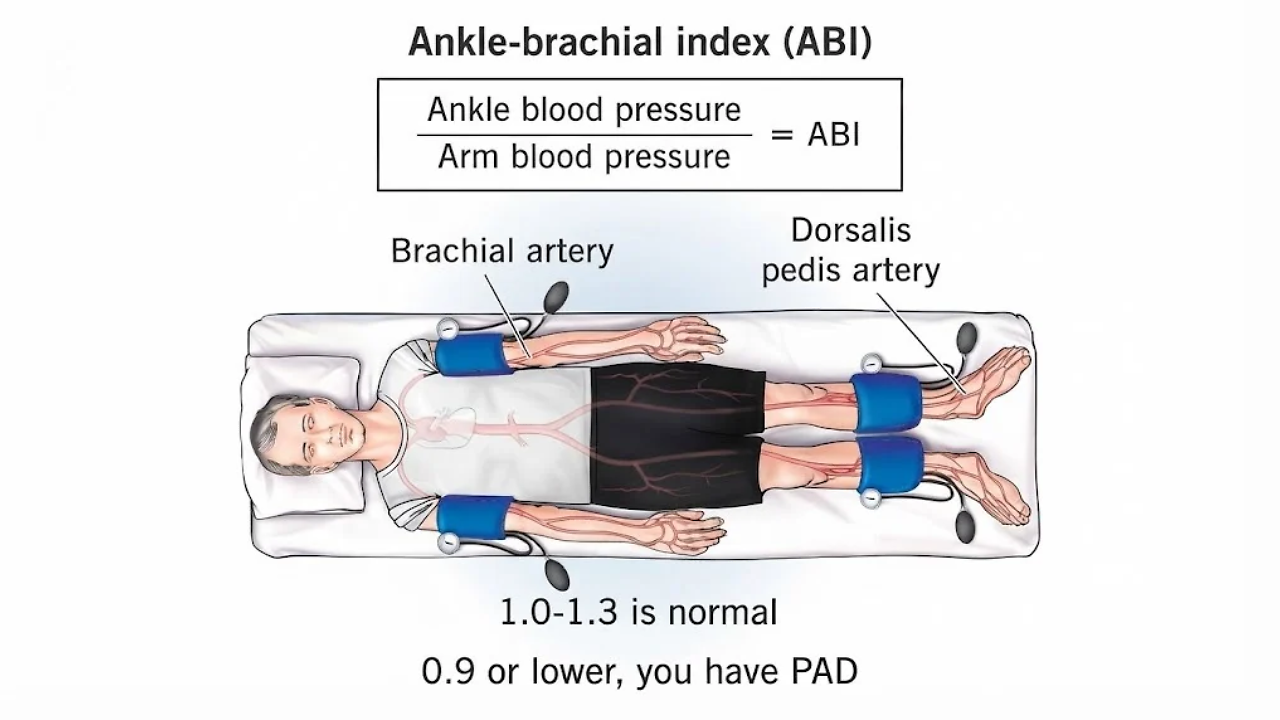
Blood pressure is routinely measured in the arms, but checking it in your ankles can also offer important clues about vascular health. An ankle-brachial index (ABI) test compares blood pressure readings in the arms and ankles to detect poor circulation and signs of peripheral artery disease (PAD).Pain or cramping in the calves, thighs, hips or buttocks while walking, climbing stairs or exercising, which subsides with rest, could indicate PAD. The condition occurs when narrowed arteries restrict blood flow to the legs.PAD can remain undetected for years, particularly in people without obvious symptoms. Early detection matters because the underlying atherosclerosis can also affect arteries supplying the heart and brain, increasing cardiovascular risks.What Is an ABI Test and How Does It Detect Artery Disease?The ABI test is a simple, non-invasive procedure that measures blood pressure in the arms and ankles using inflatable cuffs and a Doppler ultrasound device. The readings are compared to calculate the ankle-brachial index.Dr. Samir Kubba, Director and Unit Head, Cardiology, Dharamshila Narayana Superspeciality Hospital, Delhi, explained to HealthandMe that the test assesses blood circulation in the lower limbs and can also indicate an increased risk of cardiovascular disease.Dr. Anshul Kumar Jain, Director – Cardiology, CK Birla Hospital, Delhi, told HealthandMe that an abnormal ABI reading should not be viewed in isolation but as a potential warning sign requiring further cardiovascular assessment."What makes the ABI test particularly important is that PAD may remain undiagnosed for years, as some individuals experience no obvious symptoms," Dr. Samir said.Others may experience leg pain while walking, cramps, numbness, cold feet or wounds that take longer to heal.Dr. Anshul highlighted the wider implications of detecting PAD. "From a neurological perspective, identifying PAD is particularly important because underlying atherosclerosis can affect blood vessels supplying the brain as well as the heart. Reduced circulation may indicate an increased risk of cardiovascular events, including stroke," he said.Who Should Consider an ABI Test?The test may be useful for people at an increased risk of PAD, including:Smokers and former smokers, particularly those over 50.People with diabetes, high blood pressure or high cholesterol.Individuals with a history of stroke or mini-stroke.Adults over 65.People with a strong family history of cardiovascular disease.ABI is not a direct test for heart disease. It is a vascular assessment tool that helps identify PAD and may indicate wider cardiovascular risks. Abnormal results require further evaluation by a specialist.How to Prepare for an ABI Test and What Happens During It?No special preparation is required. You will be asked to lie on your back and rest for five to 10 minutes before the test.A healthcare professional will place inflatable cuffs around your arms and ankles and measure blood pressure using a handheld Doppler ultrasound device. The procedure takes only a few minutes, and you can resume normal activities afterwards.What Do ABI Test Results Mean?The ABI is calculated by dividing the higher ankle systolic blood pressure reading by the higher arm reading. The resulting ratio indicates blood flow to the legs.According to the Cleveland Clinic, ABI readings are interpreted as follows:1.0 to 1.3: Normal0.9 to 1.0: Borderline0.7 to 0.9: Mild PAD0.4 to 0.7: Moderate PADBelow 0.4: Severe PADAn ABI above 1.4 may indicate stiff or calcified arteries, often associated with ageing or diabetes. Such readings may require further testing.People with diabetes or non-compressible arteries may also need a toe-brachial index (TBI) test, which measures blood pressure at the big toe.How Is Peripheral Artery Disease Treated?Treatment depends on the severity of arterial narrowing, symptoms and overall cardiovascular risk. Options may include:Lifestyle changes: Dietary modifications, smoking cessation and management of cardiovascular risk factors.Exercise: A supervised walking programme to improve circulation.Medications: Drugs to manage PAD and associated risk factors.Procedures or surgery: Interventions to restore blood flow in cases of severe arterial blockage.