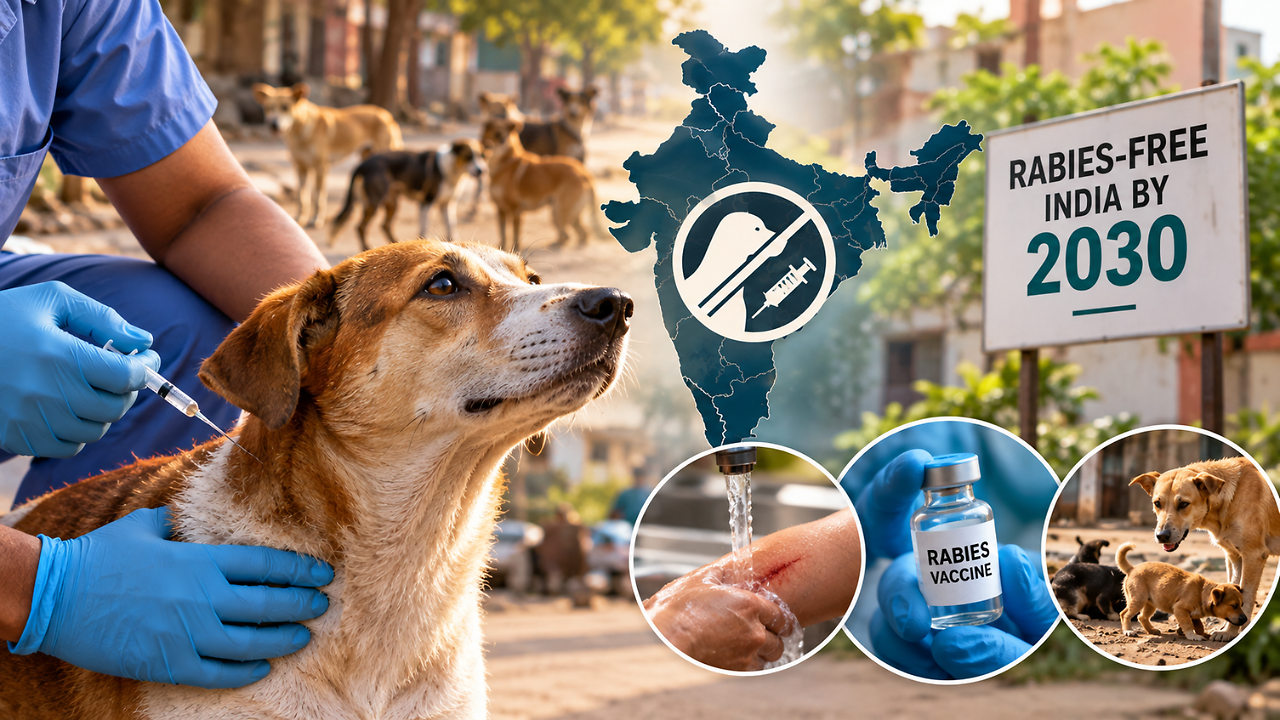
India has a target to eliminate dog-mediated rabies by 2030. It has strengthened access to post-exposure prophylaxis for people exposed to rabid animals, but controlling transmission among dogs still remains a challengge. India's National Action Plan for dog-mediated rabies elimination rests on human-health component, which focuses on post-exposure prophylaxis and awareness among bite victims, and the animal-health component, which focuses on vaccinating and sterilising stray dogs. In a conversation with HealthandMe, Dr Hanul Thukral, Veterinary Epidemiologist, South Asia Field Epidemiology & Technology Network (SAFETYNET), formerly with the Centre for One Health, National Centre for Disease Control (NCDC), Ministry of Health & Family Welfare, Government of India, says that the human-health side of the programme is strong. The bigger challenge lies in giving the animal-health side enough resources, coordination and accountability. The Gap Of Animal Health Component In RabiesDr Thukral talks about an unusual problem at the heart of India's rabies-control efforts. He speaks about the ownership of stray dogs and that they do not fall under any single ministry. “Stray dogs also do not come under a particular ministry. They do not come under the animal husbandry ministry, the health ministry or the wildlife ministry. They are under the purview of local bodies, including municipal corporations and rural local bodies,” he said. This is a larger issue as the animal-health component of rabies elimination depends on sustained vaccination and sterilisation campaigns. Dr Thukral said the country currently lacks dedicated funding and resources for this part of the effort. For India to move faster towards the 2030 goal, he said local bodies need to be given greater financial and operational support, including resources to capture rabid dogs, sterilise stray dogs and vaccinate them. He added, “There should be an incentive-based model for local bodies like Swachh Bharat. Financial or non-financial incentives could be offered to local bodies for their rabies efforts, including recognition for those that prevent the majority of deaths.”Also read: 18-Year-Old Dies From Rare Measles Brain Complication As Pennsylvania Death Toll Hits 4 Treatment Is Available But The Patient May Seek Treatment Late India's human-health response is strong. Dr Thukral said the health ministry has increased access to rabies vaccination and rabies immunoglobulins, with a goal of making vaccines available up to the PHC level and immunoglobulin available up to the CHC level. Yet the first break in the prevention chain can occur before the health system even knows a bite has happened. “The prevention chain breaks down where it actually starts. It starts with the awareness of dog-bite victims,” Dr Thukral said. “A person bitten by a dog has to recognise the danger and seek care before the health system can intervene. According to a recent estimate cited during the interview, only around 20-25% of dog-bite victims receive post-exposure prophylaxis, while 60-65% do not. Of those who receive it, only 50% complete it.” Dr Thukral stressed that these are not definitive figures. “These are just estimates based on a subset of the population,” he said. That gap can lead to delayed treatment. “In rabies, time is everything,” he said, adding, “If we don't get post-exposure prophylaxis immediately after the dog bite, after 10 hours or after 24 hours, it has virtually no use.”The 70% Dog-Vaccination Challenge Human treatment can prevent death after exposure, but elimination requires the transmission cycle to be interrupted among dogs. Around 70% vaccination coverage among dogs is needed to interrupt the transmission chain. The problem, Dr Thukral said, is that India does not have reliable nationwide data showing what proportion of its stray-dog population is actually vaccinated. He said, “A nationwide stray-dog census was only recently conducted, counting almost 1 crore 50 lakh stray dogs across the country. Local bodies and panchayats conduct surveys and organise vaccination campaigns within their jurisdictions, but the current effort is very scattered and very non-uniform.” He added, “If I achieve 70% vaccination in a particular block, the dogs of that block are protected. But there is always a chance that unvaccinated dogs from the periphery or neighbouring blocks can enter that block.”Also read: Chile Eliminates Dog-Transmitted Rabies: What Other Countries Can Learn Treatment Alone Can Prevent Deaths, But Not Eliminate Rabies Dr Thukral says saving people from rabies and eliminating rabies are not the same goal. He said, “One estimate suggests that if India continues increasing post-exposure prophylaxis coverage while carrying out suboptimal dog vaccination, around 400 deaths could be prevented over the next 10 years.” Another estimate cited by Dr Thukral puts the figure at about 400-500 deaths over the next 10 years, with spending about 5 to 10 crores. But preventing those deaths would still fall short of elimination. “That’s it. We cannot achieve elimination,” Dr Thukral said. “Humans are not the source of the infection,” he explained. “In this case, dogs or other animals are the source of infection. Unless we target them, we do not move closer to elimination.”India Does Not Have Reliable Data For Vaccinated Stray Dogs The same data problem extends to the Animal Birth Control programme, which combines sterilisation with anti-rabies vaccination. The expert says that there is no nationwide figure showing how many stray dogs have been vaccinated or sterilised. The information exists, but it sits across individual municipal corporations and panchayats rather than in one comprehensive national dataset. “Vaccinating stray dogs doesn't come under the purview of the health ministry or the animal husbandry ministry,” he said. That makes it difficult to answer a seemingly basic question: what proportion of India's stray dogs is vaccinated at any given time? “We do not have nationwide data,” Dr Thukral said.Also read: DRC Says Ebola Outbreak Has Peaked, UN Warns It’s Still Growing Reliable 'One Health' Approach Rabies is not a problem that can be solved by hospitals alone. At the district level, Dr Thukral said an effective One Health system would require health departments, municipalities, animal husbandry authorities, veterinary services and welfare bodies to have clearly defined responsibilities, adequate resources and a mechanism to coordinate. He said, “The health department would focus on post-exposure prophylaxis, animal-bite management and awareness. Local bodies would handle dog vaccination, sterilisation and solid-waste management. The animal husbandry department could provide technical support, while welfare bodies could promote responsible dog ownership. Let every department do its job and establish coordination among them.” That coordination also becomes important after an individual bite. Municipal or animal-health authorities need to communicate with the health department because one reported bite may indicate that additional people have been exposed. How To Recognise A Rabid Dog?Another challenge is recognising rabid animals. Dr Thukral said that after a dog is bitten by another rabid dog, it can take up to three months for symptoms to develop. However, he stressed that this does not mean the animal transmits the virus throughout that entire period. “It will transmit the virus about 10 days before it starts showing symptoms,” he said. He also described several behavioural and neurological changes that can raise concern. A dog that suddenly becomes aggressive, unusually quiet, or behaves differently from its normal pattern may warrant attention. Other signs described by Dr Thukral include seizures, excessive drooling, and changes in vocalisation. “The basic thing we need to look out for if we get a dog bite or exposure from a potentially rabid animal is, most importantly, change in the animal's behaviour,” he said.Also read: World Leaders Call For Obesity & NCD Prevention At BRICS 2026 Summit: Why Focus Is Growing? India’s Surveillance Gaps India's surveillance recorded 54 rabies deaths in 2024, according to the Press Information Bureau. But an independent study cited during the discussion put the number at more than 5,700, and estimated that India may have between 3,000 and 7,000 deaths annually. Dr Thukral said that India's human rabies surveillance system is well equipped to detect, diagnose and report suspected and confirmed cases. But the bigger vulnerability, he said, may occur before a suspected case enters the health system. “If there are scattered cases, such as one bite or a couple of bites, unless that patient reports to a health facility for potential post-exposure prophylaxis, the health system will most probably fail to capture it,” he said. In other words, surveillance can only record what comes into contact with the system. Community awareness and care-seeking behaviour therefore remain critical. The Biggest Challenge In India’s Rabies Elimination Goal Dr Thukral believes the health component of India's rabies programme is comparatively strong. Post-exposure prophylaxis is accessible, almost free and cost-effective, he said. But it becomes more difficult when the focus shifts to dogs. “Sterilising and vaccinating a dog currently takes around Rs 1,500 per stray dog to vaccinate it and sterilise it,” he said. With a stray-dog population of around 1.5 crores, the scale of resources required becomes enormous. According to Dr Thukral, local bodies generally do not have that kind of money to dedicate to rabies control. “So, yes, our system is very much in place and very strong to detect human rabies cases and treat them and provide them with the necessary care,” Dr Thukral said. “But for elimination, we need to target the source of the infection, which is obviously these stray dogs.” For India to reach its 2030 goal, he said, the pace needs to pick up in terms of resources, manpower and political intention. India's rabies challenge is therefore not confined to what happens after a person is bitten. It begins much earlier. With awareness, timely care-seeking, dog vaccination, sterilisation, waste management, reliable data and coordination between agencies working across the human and animal-health systems. The country can continue expanding access to post-exposure prophylaxis and prevent more deaths. But, as Dr Thukral emphasises, that alone cannot deliver elimination. The question for the next four years is whether India can move from responding to individual exposures to systematically interrupting transmission at its source. As the expert said, “We need to target the source.”