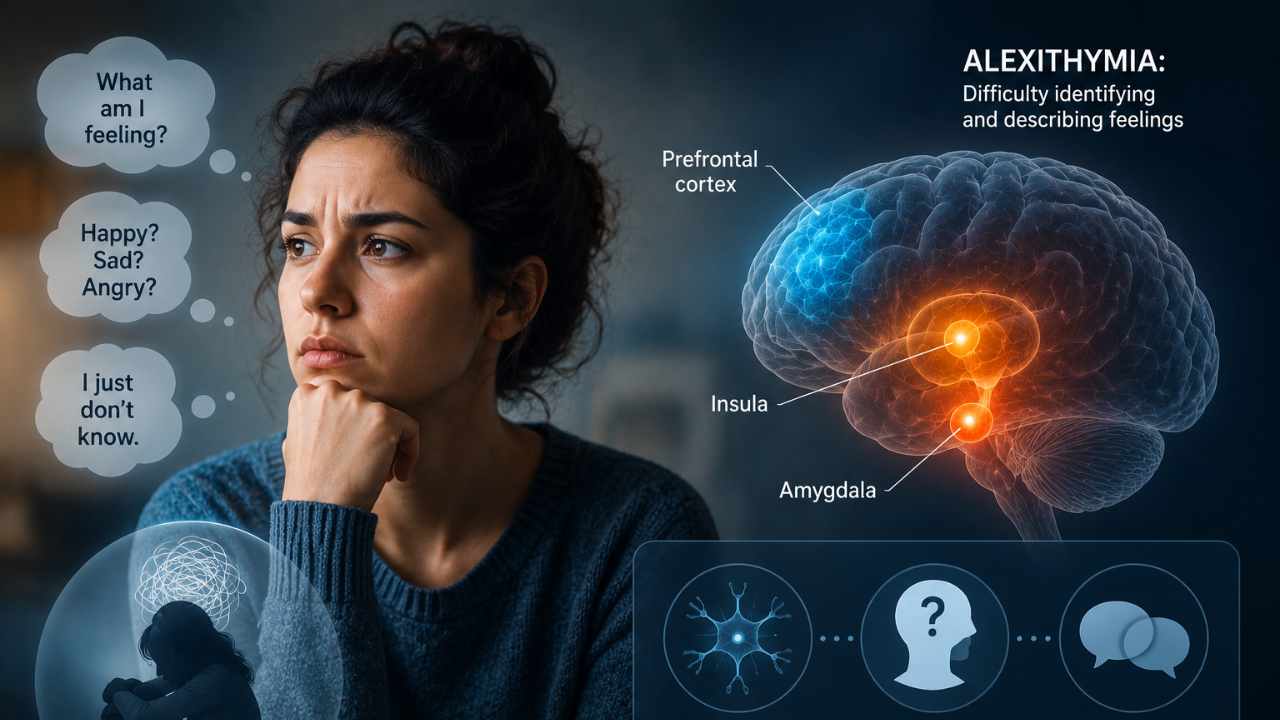
It is difficult to determine emotions because of the neurological differences, the surrounding in childhood, the psychological ways of survival, and absence of emotional training.Alexithymia or "emotional blindness" is the neuropsychological trait associated with severe problems with identification, recognition, and description of the person's emotions. Alexithymia is not a psychiatric disease but a personality trait. It is characterized by the inability to identify and distinguish emotions and body sensations, difficulty of finding the words to express feelings, inability to understand facial expression and body language of another person and emotional detachment during stressful situations. It is diagnosed in people with autism spectrum disorder, depressive disorder, generalized anxiety disorder and after traumatic brain injuries. It can be inherited or acquired as a result of childhood trauma, abuse or neurological damage.The Brain Science Behind AlexithymiaAlso read: Brain-Eating Amoeba Leaves North Carolina Teen Critically Ill: How Naegleria fowleri Affects?The cause of alexithymia is the brain wiring and neurological differences. Therefore, there is impaired interception, which is the inability of the brain to recognize its own physical sensations. Also, an unusual structure of the brain regions like amygdala and insula, that regulate emotions, makes difficult to decode emotional signals. Early childhood environment and emotional competence must be developed in childhood, because, without that, there can be emotional neglect and emotional vocabulary deficiency. Due to the inability to interpret emotional data, the person misses the compass that directs decisions and self-calming. This leads to emotional outburst, panic, hyperarousal, social and psychological consequences.How Alexithymia Differs From Emotional NumbnessAlso read: World’s First Live AI-Assisted Brain Surgery Saves Patient’s Sight: How Does The Technology Work?Emotional numbness is the transient psychological state caused by acute trauma, deep grief or burnout. The lack of emotional intelligence is the lack of social and emotional competence, when the person feels his emotions correctly, but he cannot control temper, lacks empathy, makes inappropriate social decisions or do not know what kind of effect his behaviour causes on the room. But alexithymia is different since it is long-term personality trait and the person is unaware of the particular emotion.In terms of neurodevelopment, the insular cortex and the anterior cingulate cortex (ACC) are the structural core of the brain's salience network. They work as a translator, transforming chaotic physical sensations into recognizable emotional experience. Although there isn't any cure for alexithymia, one can improve his emotional awareness through certain measures. Interoceptive training where individuals are taught how to associate physical body sensations (such as tightness in the chest) with particular emotions (such as stress). The use of emotion wheel or list of emotional words to bridge the link between vague physical sensation and precise description. Mindfulness, which involves observing oneself without judgment or without trying to suppress those internal feelings right away. And it is always good to seek professional help from a psychologist or a counselor.By Dr. Arun Shah, Director - Neurosciences, Sir H.N. Reliance Foundation Hospital