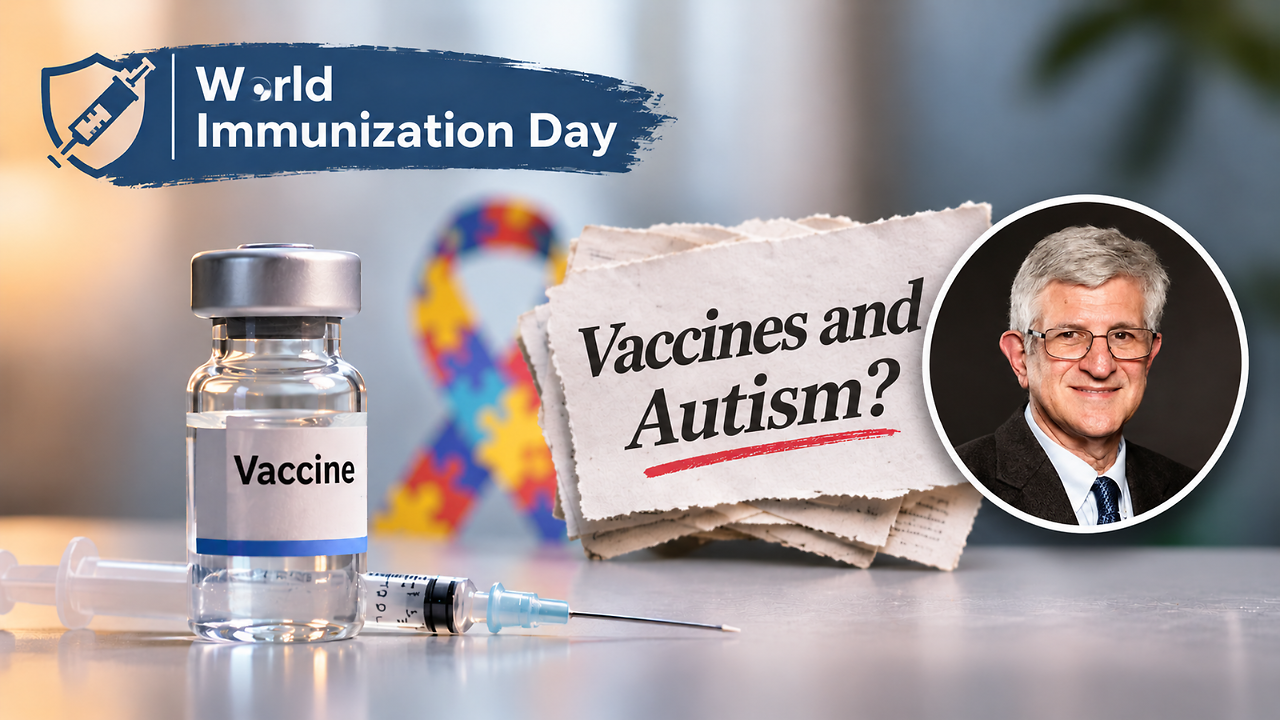
For decades, vaccines have transformed numerous fight against aggressive infectious diseases, saving millions of lives. Still, despite years and years of research proving their effectiveness, there is still significant skepticism surrounding vaccination. One of the most enduring claims is that vaccines, especially the measles, mumps and rubella (MMR) vaccine, can cause autism.The belief that vaccines can cause autism has been debated for decades, despite a solid body of research failing to establish a link between the two. In an exclusive interview with HealthandMe on World Immunization Day, Dr. Paul Offit, paediatrician and director of the Vaccine Education Center at Children’s Hospital of Philadelphia and former member of the CDC’s Advisory Committee on Immunization Practices, explained why the vaccine-autism claim is a myth difficult to debunk. Why Is The Vaccine-Autism Issue Still Debated?Also read: EXCLUSIVE: Ex-CDC Vaccine Advisor Says Measles Outbreak Bigger Than Reported, Slams RFK Jr’s ‘No-See Evil’ ApproachAccording to Dr Paul Offit, the controversy can be traced back to a 1998 paper that claimed the measles, mumps and rubella (MMR) vaccine caused autism. “I think it was born in that 1998 paper that MMR caused autism,” he said.He said that the paper did an excellent job at convincing the masses that the adverse events related to vaccines can be long-standing and irreversible, like autism. Offit said the original claim had a lasting effect on public understanding of vaccine safety.He said, “It’s very hard to unring the bell once you've rung it. I think it's hard to unscare people.”He said the public-health and academic communities responded by conducting study after study to examine the alleged association. “But vaccines don't cause autism,” Offit said.He believes that the research conducted after the 1998 paper helped address the concern. He said, “The question has been answered. Most parents of children with autism no longer believe that's the case. So I think that those studies were of value,” he said.The 1998 paper by Andrew Wakefield and colleagues, which suggested a connection between the MMR vaccine and autism, was later retracted by The Lancet. Subsequent research has not established that MMR vaccination causes autism. Offit said vaccines had been studied extensively as a possible environmental factor in autism. “Vaccines are probably the best studied environmental factor and that ain't it,” he said.Autism-Vaccine Debate Is Distracting Essential Research Also read: 'It’s The Best-Studied Vaccine In Human History': Former CDC Adviser Busts Common Myths About COVID VaccinesDr. Offit said that genetics plays an important role in autism, while several factors related to maternal health and pregnancy have also been associated with the condition. He said, “About 80% of autism is genetic.”He added, “There are a number of sort of factors regarding maternal health, regarding maternal drugs, infections during pregnancy that are associated with autism.”His comments highlight the need to understand autism through research into its different possible causes rather than focusing on vaccines. To which, Offit said that the vaccine-autism controversy has affected essential autism research.When asked whether vaccine debates were diverting resources from research into autism causes and diagnosis, he pointed to the work of Alison Singer at the Autism Science Foundation and said there were several promising areas of investigation.However, he criticised anti-vaccine groups for continuing to use autism as part of their arguments against vaccination. “I think that anti-vaccine groups have sadly taken the autism story hostage,” he said.He argued that this had reduced the attention and resources that could go towards more promising areas of autism research. “So they hurt children with autism in the end,” he said.On Revising Autism-Vaccine Debate When asked what new evidence could make him reconsider his position on vaccines and autism, Offit said he would be open to changing his mind if a particular standard of scientific evidence were met.“If there was an excellent retrospective study that controlled for things like healthcare seeking behavior, socioeconomic background, medical background, maternal health, et cetera, that was published in an excellent scientific journal and reproduced, then I'm willing to change my mind,” he said.He added that a study would have to account for factors that could influence the results and be independently reproduced. “But until then, you're just hearing a lot of conspiracy theory and hand-waving,” he said.