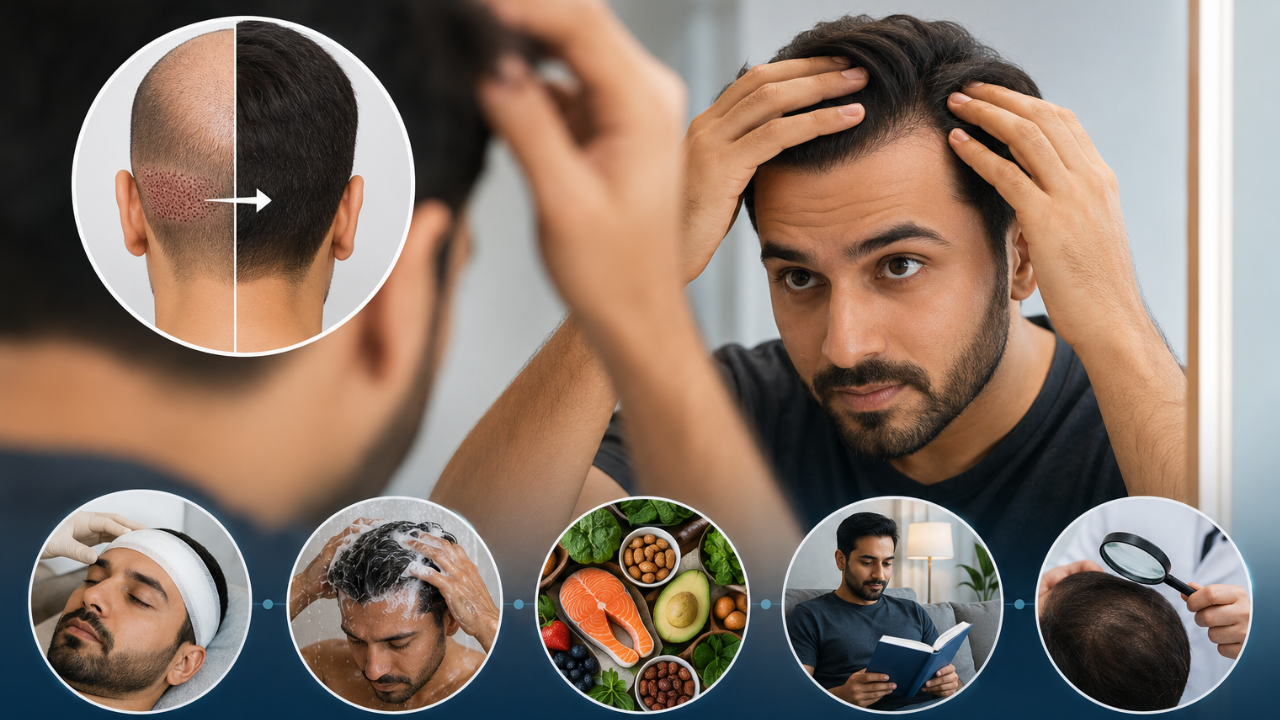
There is a conversation that comes up in almost every consultation, and it is rarely the one the patient came prepared for. After graft numbers, hairline design, cost and downtime have been discussed, the question of smoking and drinking inevitably follows — and the answer is usually a shrug: occasionally, socially, nothing serious. Yet of all the variable that determines what a patient sees in the mirror eighteen months later, these two are among the very few fully within their control, and among the most underestimated. What Smoking and Alcohol Do to the Scalp The hair follicle is one of the most metabolically demanding structures in the body, dividing faster than almost any other cell population and depending entirely on a dense network of microscopic vessels feeding its base. Nicotine constricts those vessels; over years, repeated narrowing combined with low-grade inflammation contributes to perifollicular fibrosis — scarring that gradually chokes the follicle. Tobacco smoke also floods tissue with free radicals that damage follicular DNA and accelerate genetically driven miniaturisation, which is why heavy smokers often show more advanced pattern loss and earlier greying than non-smoking peers. Alcohol takes a different route, depleting the zinc, iron, folate, B12 and protein hair is built from, while fragmenting sleep and raising cortisol — both of which push follicles prematurely into their resting phase. For a transplant candidate, this matters twice over: it reflects donor-area quality, and it signals the kind of healing environment the grafts are about to enter.Also read: The Hidden Health Risk of Sitting for Long Hours: What Young Professionals Need to Know Why the First Week After Surgery Is So Critical For the first few days after surgery, a transplanted follicle is essentially cut off from its blood supply, surviving on nutrients diffusing in from surrounding tissue. New capillaries begin connecting around day four or five, with full revascularisation taking seven to ten days — the most vulnerable window in the graft's life. Smoking attacks it from two directions: nicotine causes sustained vasoconstriction after every cigarette, while carbon monoxide binds haemoglobin more readily than oxygen, so the reduced blood reaching the scalp also carries less oxygen. The result is rarely dramatic — just poorer graft survival, patchier density, and a final outcome thinner than the graft count promised. Patients often read this as bad luck; it usually isn't. Notably, this applies equally to vaping, hookah and smokeless tobacco like gutkha or khaini — the delivery method changes, but the nicotine doesn't.Also read: Ozempic/Wegovy Vs Zepbound/Mounjaro: Which Weight Loss Drug Is More Likely To Cause Hair Loss? Study Finds Alcohol's More Immediate Risk Alcohol's damage is more mechanical. It causes vasodilation and impairs clotting, meaning patients who've been drinking beforehand bleed more during surgery — which makes graft placement less precise and can dislodge grafts already sited. Afterward, the same vasodilation worsens normal post-op swelling, its diuretic effect fights the hydration healing tissue needs, and its immune-suppressing effect arrives just as the scalp carries thousands of small open wounds. There's a medication risk too: alcohol combined with post-op antibiotics, anti-inflammatories or steroids raises the chance of gastric irritation or a genuinely unpleasant systemic reaction. Recommended Windows For smoking: stop at least two weeks before surgery (four is better), and stay off it for two weeks to a month afterwards — the long lead-in accounts for how slowly small-vessel and immune function normalise, and the long tail covers graft revascularisation. For alcohol: stop five to seven days before, and avoid it for ten to fourteen days after, or as long as medication continues, since its effects reverse faster. One caveat worth repeating: patients often say they've "stopped" when they've merely cut back. A single cigarette produces measurable scalp vasoconstriction — in this window, occasional isn't the same as fine.Also read: Love Travelling? Here's How Flying Frequently Impacts Your Health The Myth That Lifestyle Stops Mattering A costly misconception is that once surgery is done, lifestyle no longer matters. It's a half-truth: transplanted follicles, taken from the DHT-resistant back and sides of the scalp, are permanent and won't miniaturise. But a transplant only redistributes existing hair — every native follicle remains susceptible to ongoing loss. If that native hair keeps thinning, overall density falls even though every graft survives, and patients often mistake this for transplant failure. In reality, the surroundings have receded, accelerated by smoking, poor sleep, chronic stress and poor nutrition. Surgery buys a foundation; lifestyle determines how long the picture around it holds.Practical Guidance Honesty at consultation matters — knowing a patient smokes heavily changes the surgical plan toward more conservative density and staging, which protects the result. The pre- and post-op window should be treated as non-negotiable, even if permanent quitting feels distant; a defined four-week commitment is far more achievable than an open-ended one. Switching to vaping or nicotine gum isn't automatically safe — it removes carbon monoxide and tar, but nicotine, the actual vasoconstrictor, remains, so replacement therapy should be discussed with the surgeon. Fundamentals also help: adequate protein, iron and vitamin D, seven to eight hours of sleep, hydration, and gentle movement once cleared. Turning Surgery into Leverage Finally, surgery itself can be motivating. Patients who've just invested significant money and recovery time in their appearance are often more driven to quit than at any other point inBy Dr. Harikiran Chekuri, Hair Transplant Surgeon, Founder and Chief Plastic Surgeon, Redefine Hair Transplant & Plastic Surgery Center