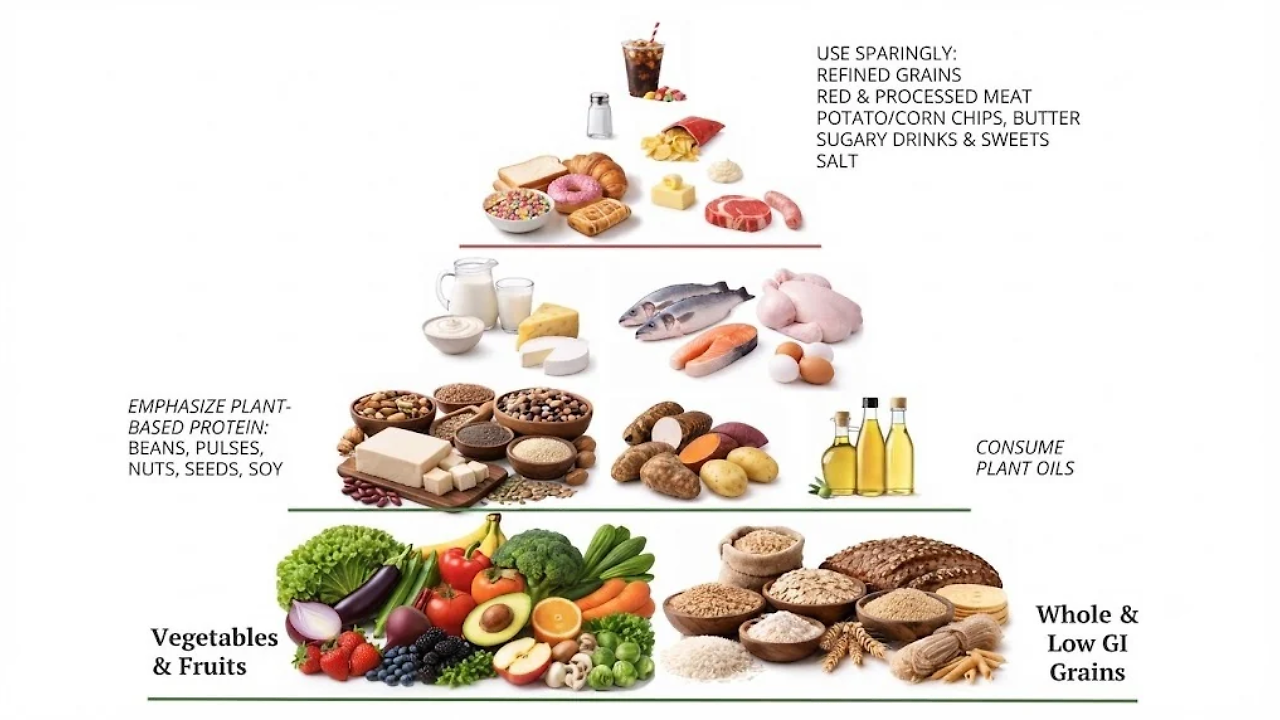
An international team of 23 nutrition scientists has developed a food pyramid emphasizing plant foods, healthier fats and high-quality carbohydrates, offering an alternative to the Trump administration’s meat-heavy dietary advice. Published in Advances in Nutrition, the International Food Guide Pyramid synthesizes evidence from more than 250 scientific publications and dietary guidelines from seven countries and regions. “Despite what people often hear, there’s actually substantial agreement in nutrition science about the foundations of healthy eating,” said Karen Della Corte, a Brigham Young University nutritional scientist who led the team. What Does The New Food Pyramid Recommend? The pyramid focuses on three principles: Make plant foods the foundation of a healthy diet. Choose healthier sources of fat and protein. Prioritize carbohydrate quality. It encourages plant-based proteins such as beans, lentils, nuts and soy, without excluding fish, poultry, eggs or dairy. The guide can also be adapted for vegetarian and vegan diets. The EAT-Lancet Commission estimates that adopting its proposed plant-forward diet could prevent approximately 15 million premature deaths annually. Why Carbohydrate Quality Matters The guide prioritizes whole grains and other high-quality carbohydrates over refined grains and sugary drinks. Carbohydrate quality depends on fiber content, processing, food structure and glycemic index (GI), which measures how carbohydrate-containing foods affect blood glucose. “For both health and sustainability reasons, carbohydrate-rich foods should provide a substantial share of our energy, so their quality is particularly important,” said Anette Buyken, a professor at Paderborn University in Germany. Traditional staples such as basmati rice, durum pasta, tortillas, rice noodles and bulgur can fit into a healthy diet, Della Corte said, depending on their glycemic index and preparation. Plant Proteins And Healthier Fats Take Priority The pyramid also recommends choosing beans, peas, lentils, fish, poultry or yogurt more often than red and processed meats. It also advises replacing saturated fats, such as butter and animal fats, with unsaturated fats from sources such as olive and canola oils. Other suggestions include choosing nuts, seeds, fruit or vegetables with hummus instead of processed snacks, whole-grain bread over refined white bread, and water instead of sugary soda. How Does It Differ From Trump’s Dietary Advice? The international pyramid contrasts with the Trump administration’s updated US dietary guidance, shaped by Health Secretary Robert F. Kennedy Jr.’s “Make America Healthy Again” (MAHA) agenda, which has emphasized meat and other animal-based foods. Rather than prioritizing red meat, the international guide stresses plant proteins, unsaturated oils and higher-quality carbohydrates. It also considers the environmental impact of food production, including greenhouse gas emissions associated with livestock farming. “Our diet has to be not only for our own health but also for the health of our planet,” said David Jenkins, a University of Toronto professor and creator of the glycemic index. The guide also highlights the importance of limiting added sugars, particularly from sugary drinks, and favors water or sugar-free alternatives. Can The Pyramid Work Across Cultures? Working with the International Carbohydrate Quality Consortium, Della Corte compared dietary guidelines from Canada, Germany, Australia, China, the Netherlands, the United States and the Nordic countries. She also reviewed more than 250 scientific publications and drew on the EAT-Lancet Planetary Health Diet to identify shared principles of healthy eating.The researchers say healthy eating does not require everyone to follow the same menu. Recommendations can be adapted to local food traditions, availability and budgets. “When you’re designing a meal, start by thinking about the plant foods you want to emphasize,” Della Corte said. “What vegetables, whole or lower-GI grains, beans or lentils could you include?” However, affordability and access can make healthier choices difficult. “We need food environments that make it easy to put the pyramid’s recommendations into practice,” Buyken said, calling for nutrition policies that address food marketing, access and prices.