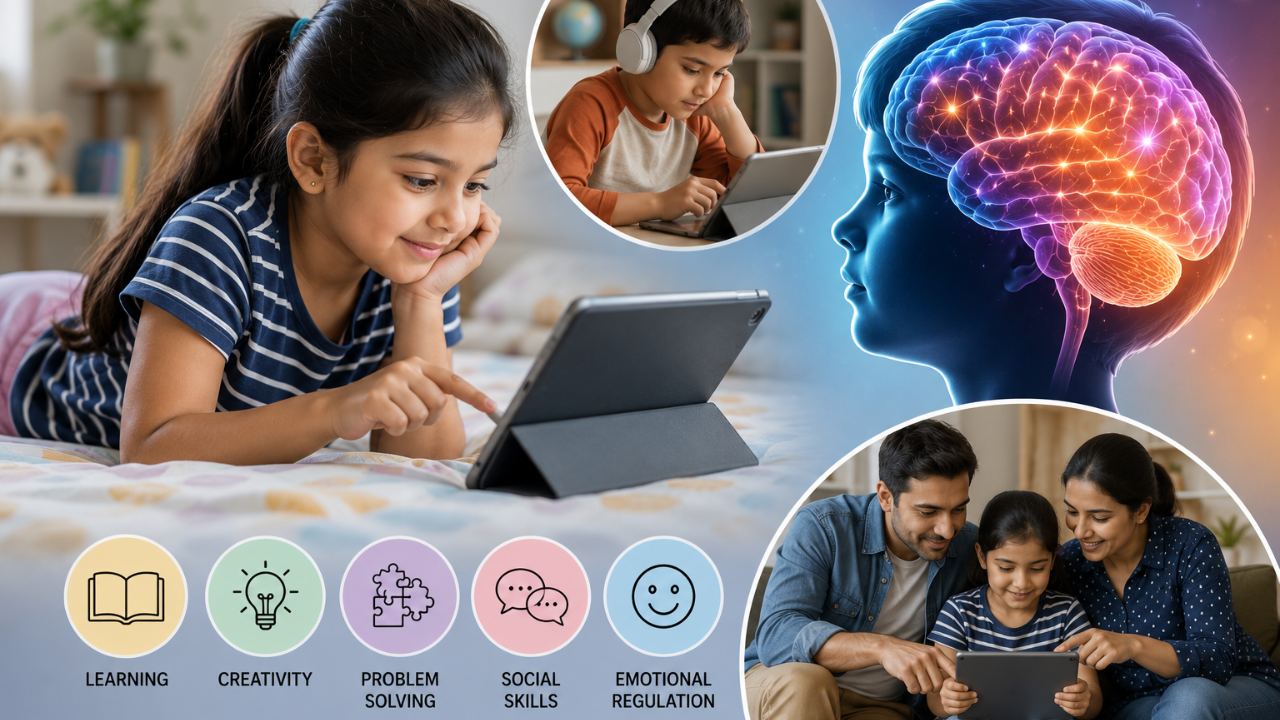
We have often linked screen time with poor outcomes, especially when it comes to children's brain health. But a new Finnish study has learnt that children who spent more time on screens from childhood through adolescence tended to show better cognitive processing as teenagers. The findings are based on an eight-year follow-up of the Physical Activity and Nutrition in Children (PANIC) study. It challenges the commonly believed idea of screen time being automatically harmful to children's developing brains. The study was conducted by researchers from the University of Jyväskylä and the University of Eastern Finland and published in Pediatric Exercise Science. However, researchers also emphasise that that the findings do not mean that children should simply spend more time on phones, tablets, or computers. What children are doing during that screen time may be more important than the number of hours alone. Children With More Screen Time Performed Better On Cognitive Tests The study is based on 260 adolescents composed of 124 girls and 136 boys, with an average age of 15.8 years. Researchers followed their physical activity, sedentary behaviour and screen use over a period of eight years. At the end of the study, the researchers examined learning, attention, and working memory. They found that greater cumulative screen time from childhood into adolescence was associated with better cognitive processing during adolescence. Despite the suspected correlation, researchers did not establish that screen use itself improved children's cognitive abilities. That distinction is important because the study was merely observational. It just identified a relationship between screen time and cognitive performance but could not prove cause and effect.Also read: Lindsay Clancy Trial: What Postpartum Psychosis Really Looks Like, From A Survivor Researchers Say What Children Do On Screens May Matter More Petri Jalanko, a doctoral researcher at the University of Jyväskylä and first author of the study, said the findings suggest that screen use should not automatically be viewed as harmful. “The findings suggest that screen time can support children’s and adolescents’ cognitive processing.” He said the type of activity children engage in could be an important factor. “Teachers and parents should encourage children to use devices and screens in such ways that promote active thinking, problem-solving, creativity and learning.” This could include activities like educational games, creating digital content, researching topics, coding, solving problems, or using technology for learning rather than passive consumption.Also read: Diabetics Must Undergo Retinal Screening To Protect Eye Health: AIIMS Doctors Not A Free Pass For Unlimited Screen Time The findings should not be interpreted as evidence that more screen time is always better. Researchers did not determine an ideal number of hours children should spend on devices. They also did not show that watching videos or scrolling social media for longer periods directly improves cognition. Instead, the study reinforced the idea that “screen time” is not one single behaviour. A child using a tablet to solve a mathematics problem is doing something very different from a child spending hours passively scrolling through short-form videos. Jalanko said, “We should not regard screen time solely as harmful but seek balance between physical activity and screen time that promotes active thinking.” Eero Haapala, senior researcher in the study, and Jalanko emphasised that the relationship between physical activity, sedentary behaviour and cognition is complex. Haapala said, “Our study indicates that the connections of physical activity and sedentary behaviour to cognitive processing are complex and depend on the sex, the type and assessment method of physical activity and sedentary time.”