
- Health Conditions A-Z
- Health & Wellness
- Nutrition
- Fitness
- Health News
- Ayurveda
- Videos
- Medicine A-Z
- Parenting
Sleep Terrors In Children: Warning Signs And What Parents Should Do
Credit: Canva
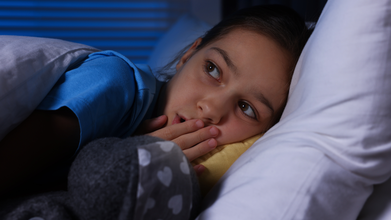
Seeing your child suddenly screaming at night, with wide eyes and thrashing limbs, can be deeply unsettling. However, remaining calm and focusing on safety is crucial for parents during the sleep terror episodes, said health experts.
Sleep terrors, also known as night terrors, are episodes of sudden fear, screaming, or intense distress that occur during sleep.
The condition is more common in children, especially between the ages of 3 and 8 years, as their sleep patterns are still maturing.
Unlike nightmares, which usually happen during dreaming (REM sleep) and are often remembered, sleep terrors occur during deep non-REM sleep.
Dr Preeti Singh, Senior Consultant, Clinical Psychology, Max Super Speciality Hospital, Dwarka told HealthandMe, that while it may be frightening to witness, especially for parents, sleep terrors themselves are usually not harmful.
Although most kids outgrow this naturally, if the episodes are violent or very frequent, consult a specialist, added Dr Sudhir Kumar, a neurologist at Apollo Hospitals, Hyderabad.
What Are Sleep Terrors
During sleep terror, the child may sit up abruptly, shout, appear frightened, sweat, breathe rapidly, and be difficult to console. In most cases, they do not recall the episode the next morning.
Sleep terrors typically occur in the first third of the night, during deep sleep (slow-wave sleep). They are considered a type of parasomnia, meaning an unusual behavior during sleep.
Dr Kumar, in a post on social media platform X, explained that unlike a bad dream, a sleep terror happens in deep sleep (Stage N3).
It is characterized by abrupt sitting up/screaming, with physical signs that include a fast heart rate, sweating, and dilated pupils.
"It is 11 PM. Your child suddenly sits up, screams at the top of their lungs, and looks terrified. They are not responding to you, and they seem to be looking right through you. This is likely a sleep terror (night terror), a common NREM sleep parasomnia in children aged 3-12,” said Dr Kumar, popularly known as the Hyderabad doctor, on X.
The expert noted that the children are unlikely to recognize the parents and be "consoled" during the episodes.
What Factors Trigger Sleep Terrors
- Sleep deprivation or irregular sleep schedules
- Fever or illness
- Emotional stress or anxiety
- Major life changes or trauma
- Family history of parasomnias
- Certain medications
For children, sleep terrors are often developmental and tend to reduce as the nervous system matures, Dr Singh told HealthanMe.
How Can Parents Respond?
Parents often feel alarmed during a sleep terror episode, but the key is to remain calm, the experts said. They said during an episode:
- Do not try to fully wake the child, as this may increase confusion and agitation.
- Gently ensure the child is safe and cannot injure themselves.
- Speak softly and reassuringly, even if they do not respond.
- Wait for the episode to pass, which usually happens within a few minutes.
Other preventive measures include:
- Maintaining a consistent bedtime routine
- Ensuring the child gets adequate sleep
- Reducing screen time before bed
- Managing stress during the day
- Creating a calm and secure sleep environment
How To Manage
Most children do not require medical treatment, as sleep terrors usually resolve on their own with age. Treatment is considered when episodes are frequent, severe, cause injury, or significantly disrupt family life.
However, addressing sleep deprivation, treating any underlying medical conditions (e.g., sleep apnea), counseling or stress management strategies can help.
Measles In Mexico: Do Parents Need To Show Vaccination Schedule To Get Their Children Enrolled In Schools?
Credits: Canva
Mexico has reported more than 2,700 new cases of measles so far this year, as per the government data. Most of these infections have been detected among infants and young children. Not too far away, in the US, as per the Centers for Disease Control and Prevention (CDC) data, 900 new cases have been confirmed.
However, unlike in the 1990s, the Secretary of Public Education in Baja California Sur, Alicia Meza Osuna, clarified that it is not a requirement to present the complete vaccination schedule for children to attend schools. However, in the Mexican city of Cabo San Lucas, specific health measures are being taken.
Also Read: Epstein Files: Post-mortem Notes And New Documents Shed Light On Late Sex Offender's Death
What Parents In Cabo San Lucas Must Keep In Mind?
- The standard school enrollment process will continue as usual, and families are not required to present a complete vaccination record to register.
- In areas where recent cases have been reported, localized health precautions may be introduced. Families in Cabo San Lucas should be prepared for temporary preventive measures if an outbreak occurs.
- Parents are advised to take their children to a medical facility if they notice symptoms such as fever, cough, runny nose, conjunctivitis, small white spots inside the cheeks, or skin rashes so they can receive timely medical care.
- Except during declared emergencies, vaccination certificates are not required for school admission.
What Happened In Mexico In The 1990s?
In the 1990s, the Ministry of Health (SSA) and the Ministry of Public Education (SEP) required that children be protected against diseases such as measles, polio, rubella, tetanus, diphtheria and tuberculosis before entering preschool or primary school, as part of the health prevention policies. However, at present, as Alicia Meza Osuna stated, "It is not a requirement to enroll children in school to present their vaccination card. Under no circumstances is it a requirement to present a complete vaccination schedule for a child to attend school."
What Is Measles?
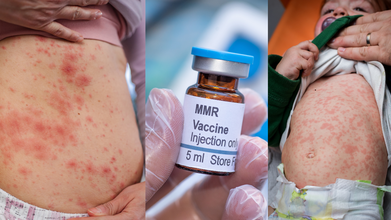
Measles, also known as rubeola, is an extremely contagious viral illness that typically causes high fever, cough, runny nose, red and watery eyes, and a characteristic rash that begins on the face and spreads downward across the body. It spreads through respiratory droplets and can lead to severe and sometimes fatal complications, including pneumonia and inflammation of the brain known as encephalitis.
Although it is preventable through the safe and effective MMR vaccine, measles remains a serious threat in many regions. There is no specific cure, and treatment focuses on managing symptoms, according to the Cleveland Clinic.
What Are The Symptoms Parents Must Look Out For?
Measles has a high transmissibility, and high measles immunity levels are required to prevent sustained measles virus transmission.
This is why herd immunity for measles could be easily breached.
It easily spreads from one infected person to another through breathes, coughs or sneezes and could cause severe disease, complications, and even death.
Symptoms include:
- High fever
- Cough
- Runny Nose
- Rash all over the body
The most unique symptom or the early sign of measles in the Koplik spots. These are tiny white dots that look like grains of salt on red gums inside the cheeks that appear before the red rash starts to appear on a person's face and then the body.
Read: Unique Symptoms Of Measles In 2026 And How Long Does The Infection Last?
Furthermore, the symptoms of measles are also characterized by the three Cs:
- Cough
- Coryza or runny nose
- Conjunctivitis or red and water eyes
How Long Does The Infection Last?
The progression of the symptom comes in two stages, first is the prodromal stage or Days 1 to 4, where one would notice high fever, cough, runny nose, red and watery eyes, sore throat, fatigue, and Koplik spots.
The second stage is called the rash stage or the days 5 to 10 or even more where rash start to appear on the hairline, and then it runs down the body. It lasts for several days and fades in the same order.
The first symptoms, notes the Centers for Disease Control and Prevention (CDC), appear 7 to 14 days after a measles infection. Often, it could also lead to ear infection, or even diarrhea. Though these complications happen in every 1 in 10 children or individual with measles.
Parents Across the U.S. Report Difficulty Finding Mental Health Care for Their Child

Credits: Canva
As per the American Psychological Association (APA), only 58.5 per cent of US teens always or usually receive the social and emotional support they need, as per the report by the US Centers for Disease Control and Prevention (CDC).
Another National Institutes of Health (NIH, US) report notes that the most mental health disorders among children ages 3 to 17 in 2016 to 2019 were attention deficit disorder (9.8%, approximately 6 million), anxiety (9.4%, approximately 5.8 million), behavior problems (8.9%, approximately 5.5 million), and depression (4.4%, approximately 2.7 million). For adolescents, depression is concerning because 15.1% of adolescents ages 12-17 years had a major depressive episode in 2018-201.
However, not all are able to receive the help, in fact, parents too find themselves struggling when it comes to helping their children.
Despite growing concern about a mental health crisis among young people in the United States, a large national study suggests the care system continues to fall short for many families.
Researchers from the Harvard Pilgrim Health Care Institute in Boston found that nearly one quarter of children who require mental health treatment are not receiving it.
The findings come from survey data collected from more than 173,000 households between June 2023 and September 2024.
Many Families Recognize the Need but Cannot Get Help
The analysis showed that about one in five households, or 20 per cent, had at least one child who needed mental health support. Yet among those families, nearly 25 per cent said those needs were not met.
Even families that eventually obtained care often faced significant hurdles. Nearly 17 per cent described the process as difficult and exhausting.
The research letter was published February 16 in JAMA Pediatrics.
Household Structure Shapes Access
The study found that family circumstances strongly influenced how easy it was to navigate the health care system.
Families with multiple children reported higher unmet needs at 28 per cent, compared with 21 per cent in households with only one child. Single parent households also reported more difficulty securing appointments.
Education setting played a role as well. Homeschooled children had higher unmet needs at 31 per cent compared with 25 per cent among children attending public school. Researchers suggest this may reflect the absence of school counselors and other school based support systems.
Insurance and finances created additional barriers. About 40 per cent of families covered by Medicaid or without insurance said they could not get care specifically because it was too hard to access.
In a news release, lead author Alyssa Burnett said nearly one quarter of parents reported that at least one child did not receive needed mental health care, highlighting persistent access gaps.
Cost, Availability and Logistics Remain Major Obstacles
Researchers noted several common barriers. Families cited treatment costs, a shortage of clinicians and logistical issues such as scheduling and travel.
The study also found disparities among racial and ethnic groups. Families from minority backgrounds had higher rates of unmet needs compared with non Hispanic white households. However, Black households reported less difficulty accessing care at 13 per cent compared with 17 per cent among white households.
Bringing Care Closer to Families
Experts involved in the study say improving access may require shifting where care is delivered.
Senior author Hao Yu, an associate professor of population medicine at the institute, said states should expand the child mental health workforce and integrate mental health services into primary care settings to remove barriers and improve access to needed treatment.
Stay Alert During Pregnancy: Common Infections Women Should Watch Out For

A majority of women may experience infections during the crucial phase of pregnancy. Some infections during pregnancy may also not show clear symptoms. However, timely awareness and prevention can protect both the mother and the baby.
Pregnancy is a special and sensitive phase in a woman’s life. While most women focus on nutrition and regular check-ups, infections during pregnancy can often be neglected.
Some infections may cause only mild symptoms in the mother but can seriously affect the unborn baby if not detected early. Hence, regular screening, good hygiene, and timely medical care are crucial to prevent most pregnancy-related infections and ensure a safe and healthy pregnancy.
Common Infections During Pregnancy
- Urinary Tract Infections (UTIs)
- Vaginal infections
- Respiratory infections
- TORCH infections
- Hepatitis B and C can be passed from mother to baby during childbirth if not properly managed.
Tips To Follow To Prevent Infections During Pregnancy
- Pregnant women should go for regular antenatal check-ups, maintain good personal hygiene, and not use any chemical-laden products.
- Stay hydrated and drink enough water, eat home-cooked food, avoid raw or undercooked items, wash your hands frequently, and get vaccinated as recommended by the doctor.
- Take a flu shot on a priority basis. Avoid contact with rodents and pets.
- Make sure to consult the expert in case of symptoms such as fever, pain, or unusual discharge for prompt intervention.
- Get tested for sexually transmitted diseases (STDs) such as HPV, chlamydia, gonorrhea, herpes, syphilis, and trichomoniasis.
- Early detection and treatment will be beneficial in safeguarding both mother and baby and ensuring a healthy pregnancy.
- Follow Us :


© 2024 Bennett, Coleman & Company Limited