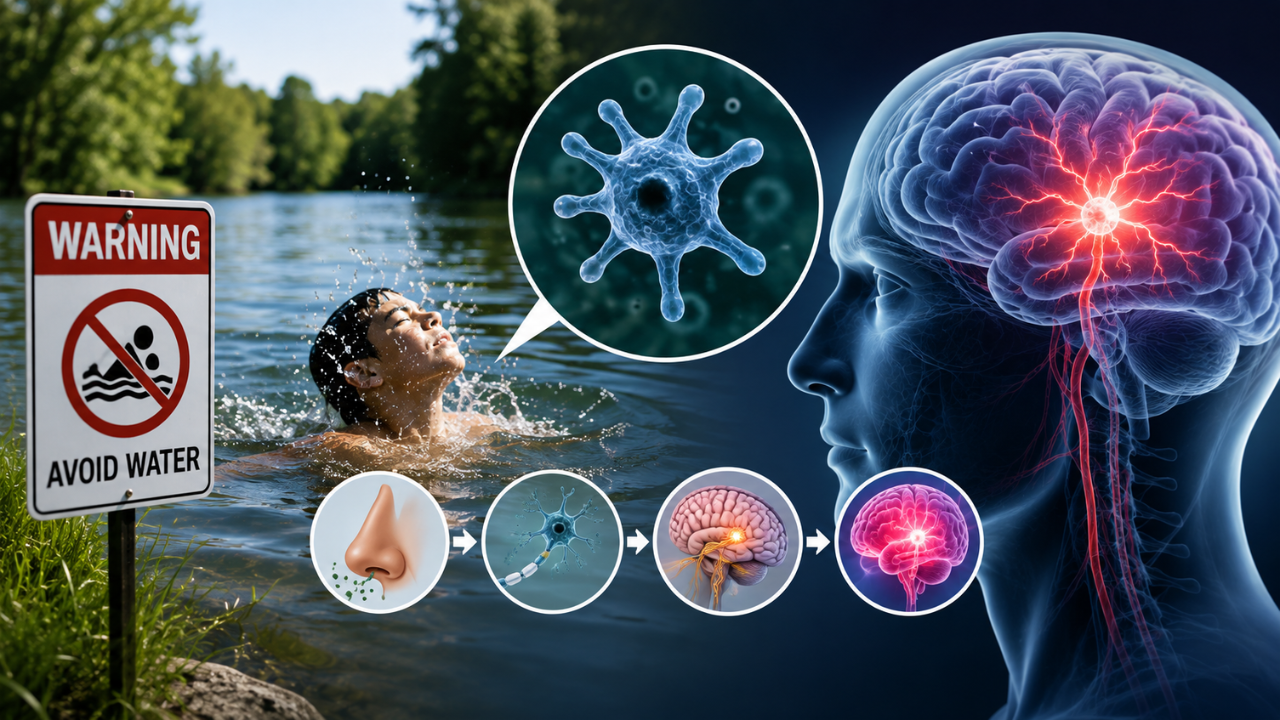
Louisiana health officials have confirmed a rare infection caused by Naegleria fowleri, commonly called the “brain-eating amoeba,” in a resident who most likely contracted the infection after swimming in Lake Claiborne in Louisiana.The Louisiana Department of Health confirmed the case this week, issuing a warning to people entering warm freshwater. It is the fourth documented Naegleria fowleri infection in Louisiana since 1937. The case comes as health officials continue to warn about the seasonal risk of the amoeba, which thrives in warm freshwater, particularly during the summer months. According to CDC data, most US cases occur in July and August. The Amoeba Enters Through The NoseNaegleria fowleri does not simply infect people when they enter or swim into contaminated water. The infection occurs when water containing the amoeba goes up the nose. From the nasal pathway, the organism can travel along the olfactory nerves into the brain and cause primary amebic meningoencephalitis (PAM), an infection that progresses rapidly and causes inflammation and destruction of brain tissue. Swallowing contaminated water also does not cause Naegleria infection, and the infection cannot spread from one person to another.Also read: Fournier Gangrene: Woman Develops Rare Flesh-eating Infection After Bikini Shave, Herbal Application Louisiana Health Officials Warn PeopleNaegleria fowleri is naturally found in warm freshwater lakes, ponds and rivers, as well as some hot springs and other warm-water environments.According to CIDRAP, the amoeba can survive at temperatures as high as about 115°F (46°C). Cases are particularly linked with freshwater exposure during periods of high temperatures. The risk remains extremely low despite its potentially devastating outcome. The CDC recorded 180 PAM cases in the US from 1937 through 2025, with cases ranging from zero to eight per year.The LDH said recreational water users should not assume that warm freshwater is completely risk-free. “Though the risk of infection is low, recreational water users should always assume there is a risk when they enter warm fresh water.” The department added that people can reduce their risk by preventing water from entering your enters the nose. That can include using nose clips or keeping the nose above water when swimming in warm freshwater.Also read: Can You Contract Deadly Flesh-Eating Bacteria At The Beach? Louisiana Health Officials Warn BeachgoersSymptoms Can Mimic MeningitisPrimary amebic meningoencephalitis can initially mimic other infections. Early symptoms can include headache, fever, nausea and vomiting. As the infection progresses, patients can develop a stiff neck, confusion, problems with balance, seizures, hallucinations and loss of consciousness. The illness progresses extremely quickly, with CDC data indicating that symptoms generally begin within 1 to 12 days after exposure. Death can occur within days after symptoms appear. As the disease is extremely rare and its early symptoms resemble other forms of meningitis, diagnosis can be challenging.The Louisiana case follows another recent case in the state involving an 8-year-old Ruston girl, who was hospitalized after developing a Naegleria fowleri infection that health officials said may have been acquired while swimming in a North Louisiana lake. Simple Precautions Can Reduce ExposureThe cases highlight the importance of taking precautions around warm freshwater during the summer, even though the overall probability of infection remains extremely small.The CDC recommends avoiding activities in warm freshwater when possible, particularly during periods of high water temperatures. People who do enter such water can reduce exposure by using nose clips or keeping their head above water, and by avoiding stirring up sediment in shallow, warm areas. Another important precaution concerns nasal rinsing. Naegleria can also be transmitted when contaminated tap water is used in devices such as neti pots. For nasal rinsing, the CDC recommends using distilled or sterile water, or water that has been boiled and cooled.