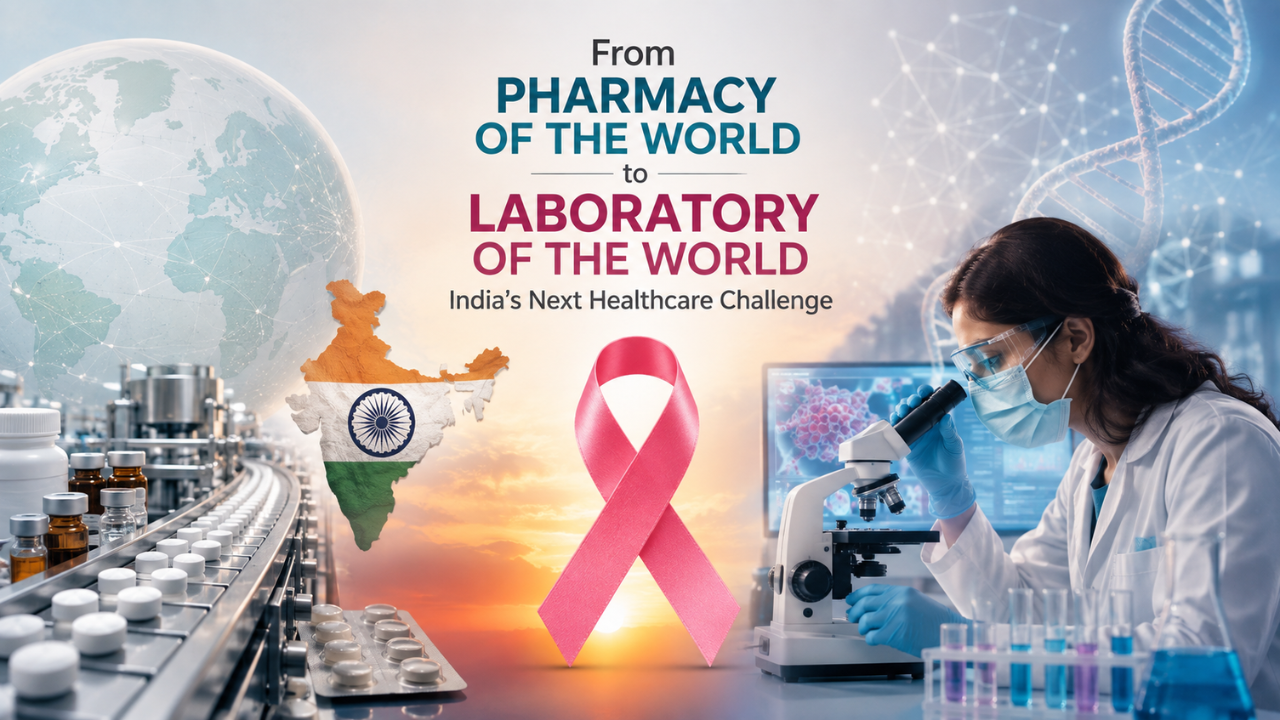
August 18 marks World Breast Cancer Research Day, a day that reminds us that every major breakthrough in cancer care has its roots in research. The medicines that are prescribed, the diagnostic technologies that we use, the targeted therapies that we offer and our growing understanding of why cancers develop and spread, are all outcomes of regular scientific research. India carries one of the world's largest cancer burdens. According to IARC's GLOBOCAN 2022 estimates, India recorded approximately 1.41 million new cancer cases and more than 916,000 cancer deaths in 2022. Breast cancer alone was the leading cancer among Indian women and also the leading cancer overall. India as a country, has a large and diverse patient population, significant clinical expertise, strong medical institutions and a pharmaceutical industry with enormous manufacturing capabilities. But there is a crucial gap between manufacturing what the world has already discovered and researching newer medical opportunities. A significant proportion of cutting-edge cancer research continues to emerge from countries with substantially larger and more established research ecosystems. When scientific discoveries, new molecules, diagnostic technologies or treatment approaches are developed elsewhere, Indian patients benefit from them at a later stage. We Need To Move Beyond A Few Centres Of ExcellenceWe have limited institutes that have made important contributions to cancer care and research. But considering India's population and cancer burden, the scale of research infrastructure needs to expand substantially. We need more dedicated cancer-research institutes, stronger university hospital industry collaborations, modern laboratories, biobanks, genomic databases, data-science capabilities and trained physician-scientists. Cancer is not just one disease. It comprises of multiple biological subtypes, and the way a tumour behaves can vary significantly between individuals and populations. Therefore, India needs research that focusses specifically towards Indian patients.Also read: Groundbreaking Experimental Vaccine May Prevent Pancreatic Cancer From Spreading, Early Trial Finds Clinical Trials Can Be Part Of The Solution India has a formal Clinical Trials Registry, and the registry currently records more than 100,000 trials across areas of medicine. For eligible patients, participation in an appropriate clinical trial may provide access to an investigational therapy or treatment strategy that is not yet routinely available. Clinical trials generate evidence that can improve future treatment for thousands or millions of patients.Also read: UK Set To Implement Stricter Protocol For Prostate Cancer Testing; Who Is Eligible To Get Tested? Research Needs To Become A Policy Priority We need to create an ecosystem that moves from discovery to translation to patient care. That means incentivizing research institutions and researchers, supporting young physician-scientists, strengthening public-private partnerships and making it easier for promising discoveries to move from laboratories into clinical development. We need to have an ecosystem, where healthcare research, particularly research addressing diseases with an enormous Indian burden should receive a much greater and more targeted share of national research investment. A large, diverse population can generate valuable real-world evidence. Large patient cohorts can help researchers understand disease patterns. Indian genetic and molecular data can help answer questions that may not be adequately addressed through studies conducted in other countries. From Manufacturing Medicines To Discovering The Next Generation Of Treatments India has already demonstrated that it can serve the world as a pharmaceutical manufacturing powerhouse. We should look at also becoming the research hub for the world by combining our pharmaceutical manufacturing strength, clinical expertise, technology capabilities and patient population. The opportunity is already in front of us. What we need now is the policy ambition to implement it. By Dr. Kapil Goyal, Consultant – Medical Oncology, Rajiv Gandhi Cancer Institute & Research Centre (RGCIRC)