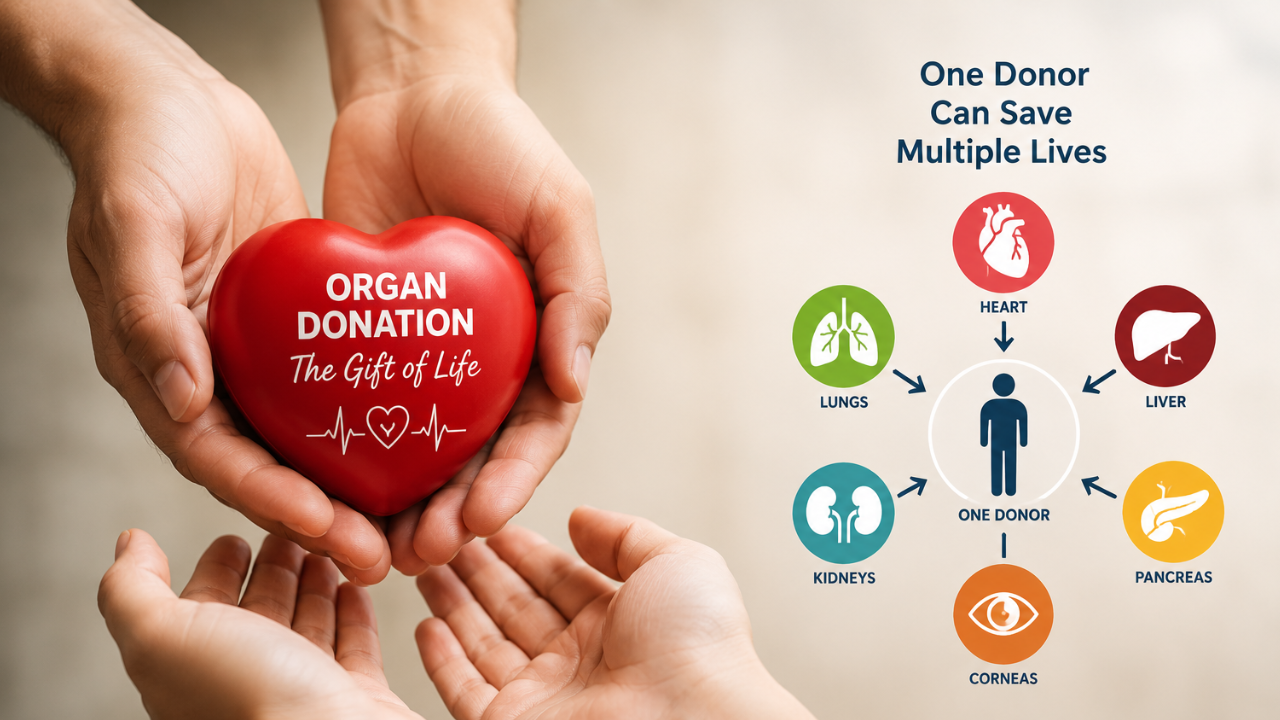
Organ donation is one of the most profound ways in which we can give the gift of life to another person. World Organ Donation Day, observed every year on August 13, is an opportunity to raise awareness about organ donation, address common myths and encourage more people to consider pledging their organs. India has a large number of patients waiting for organ transplants, including transplants of the liver, kidney, heart, pancreas, intestine and other organs and tissues. Despite the significant need, organ donation rates remain low, with lack of awareness and several misconceptions continuing to be major barriers. One organ donor can potentially save multiple lives. However, for this to happen, it is important that people understand the process and make an informed decision about organ donation during their lifetime.Busting Common Myths About Organ Donation1. “My religion does not permit me to donate my organs.”Organ donation is not prohibited by any religion. This issue has been discussed with religious representatives from different faiths, and organ donation has been broadly recognised as an acceptable act, both during a person’s lifetime and after brain death.2. “Organs can only be donated after the heart stops beating.”For most organs, donation after brain death is possible when the brain has permanently stopped functioning, but the heart is still beating, which generally occurs in an intensive care setting. Corneas can also be donated after death within a limited time period. This is why pledging your organs during your lifetime and discussing your decision with your family is important.3. “Organ donation will disfigure or mutilate the body.”Organ retrieval is performed by trained medical specialists in an operating theatre. The surgical incision is carefully closed after the procedure, and the body is not mutilated.Also read: Post-Organ Donation And Transplant Care: How Can Donors And Recipients Stay Healthy?4. “I can buy a kidney or liver for my family member.”Organ donation and transplantation are regulated by law. The sale and purchase of human organs is prohibited and is a punishable offence.5. “If I donate a kidney, I will become weak or handicapped.”A healthy person who is found suitable for living kidney donation through the required medical evaluation can generally continue their normal life after donation. The remaining kidney is capable of maintaining normal kidney function.6. “A kidney donor has to take lifelong medicines.”Kidney donation does not mean that a healthy donor has to take lifelong medication simply because they have donated a kidney. Some pain medication may be required during the initial recovery period, while the remaining healthy kidney continues to perform its function.7. “I will have severe dietary restrictions after donating a kidney.”According to the source material, kidney donors do not generally need specific dietary restrictions solely because they have donated a kidney, as the remaining kidney continues to maintain normal kidney function.8. “I will not be able to have children after donating a kidney.”Both men and women who donate a kidney can have children. For women, the source recommends waiting one year after donation before becoming pregnant to allow the body to recover completely.9. “I am over 60, so I am too old to donate.”Age alone does not determine whether someone can donate. The health of the donor and the condition of the organs are important considerations, and suitability is determined through medical evaluation.Also read: World Organ Donation Day 2026: Too Old Or Too Sick To Donate Organs? Doctors Bust Key MythsWhat Can We Do To Encourage Organ Donation? • Consider pledging your organs during your lifetime and communicate your decision clearly to your family.• Talk to your family, friends and colleagues about organ donation and help dispel common myths.• Encourage community organisations to participate in creating awareness around organ donation.• Do not assume that you are medically unfit to donate. A team of medical experts evaluates the donor and determines suitability.• Organ donation is a completely voluntary decision. No individual should be pressured into donating an organ.• Patients waiting for an organ transplant should approach a licensed transplant hospital and complete the necessary registration formalities, including through the NOTTO system.Organ donation is ultimately about giving someone another chance at life. We should not take our organs with us; they can be used to save lives and give hope to those waiting for a transplant.By Dr Sanjeev Gulati, Chairman, Nephrology, Fortis, Vasant Kunj