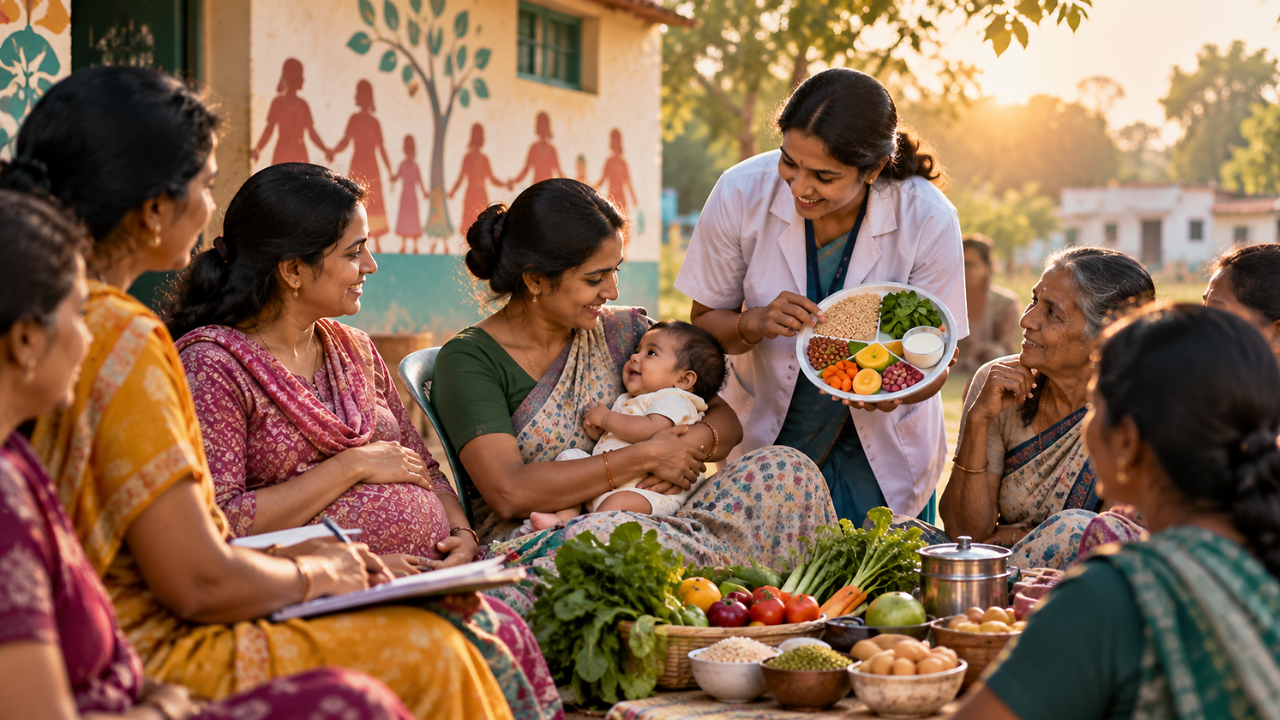
In India, over half of adolescent girls and women are anaemic; one-fifth have low Body Mass Index, while micronutrient deficiencies like Vitamin D and Vitamin B12 affect 60% and 53% of girls and women, respectively. The resulting lack of energy, poor ability to concentrate, bone pain, chronic fatigue, insomnia, and a variety of other health challenges cause significant loss of quality of life, poor productivity, and high morbidity among women.The multifactorial causation theory of nutrition effectively defines that, alongside nutrition-specific factors, nourishment depends on nutrition-sensitive factors, including socio-economic and cultural factors, that are often shaped by communities.Although women almost universally prepare food at home, gender norms compel women to prioritise serving food to family members before themselves, resulting in smaller portions and nutritionally inferior diets for themselves. This is particularly harmful to women when the demands of the body are high, such as during adolescence, pregnancy, breastfeeding, and peri-menopause. To break such harmful practices reinforced through generations, focused social and behaviour change (SBC) strategies that foster community action are essential.Re-Positioning Women’s Nutrition for Effective Behaviour ChangeThe objective of SBC is to change knowledge, attitudes and practices of target groups and stimulate social change at the local and national level. Good SBC efforts can encourage community engagement, influence social norms, support policy advocacy, promote service uptake, reach underserved populations and foster a media environment that resonates with downstream engagement. Community Action can be an outcome of a good SBC effort.An SBC approach meant to centre a woman’s nutrition needs within a household must target all decision makers within that family and community such as husband, mothers-in-law, elders, local leaders and other influencers. Rather than adopting a narrow woman-centred approach, messages that position the health and nutrition of a woman as central for the well-being of the entire family are more effective. Communication strategies that emphasise outcomes that are valued by families, such as better nutrition leading to a reduction in sickness-related income loss, decreased healthcare expenditure, increased savings and improved productivity, are more appealing and acceptable in Indian and other similar societies. Such framing aligns women's nutritional needs with aspirations families are motivated to achieve.Behaviour change rarely occurs after a single exposure to a message. New ideas gain acceptance when repeated consistently by trusted community sources like ASHAs, Anganwadi Workers, SHG leaders, Panchayat representatives, faith-based leaders, community elders, and frontline health workers. Consistent messaging across platforms builds trust, creates social acceptance, and gradually shifts expectations regarding women's health.Also read: Eating 4–6 Servings of Whole Grains Daily May Lower Heart Disease RiskFostering Community-Led Collective ActionEvidence demonstrates that community-led collective action effectively shifts entrenched norms. Women's collectives provide safe spaces for discussion, peer learning, and collective problem-solving, becoming agents of social change rather than mere beneficiaries. Sustainable improvements require interventions operating simultaneously across multiple levels:Individual level: Knowledge, confidence, and agency for informed nutritional choices.Household level: Positioning women's health as essential for effective caregiving, household productivity, reduced healthcare costs, and overall family well-being.Community level: Women's collectives, SHGs, youth groups, Panchayats, and faith-based organisations fostering dialogue and establishing healthier behaviours as socially desirable.Institutional level: Frontline workers requiring training, supervision, and culturally appropriate tools for consistent messaging.Policy level: Integrating nutrition with livelihoods, women's empowerment, social protection, and primary healthcare rather than isolated sectoral programmes.Also read: Can An Overweight Child Be Malnourished? Signs Of Hidden Malnutrition In KidsLessons from Implemented ProgrammesJEEViKA, Bihar's State Rural Livelihoods Mission, demonstrates effective change. Rather than presenting maternal and child nutrition as isolated health issues, JEEViKA positioned nutrition within household well-being. Messages focused on how improved food practices enhance productivity, increase income, and strengthen family well-being. This framing resonated with household priorities and encouraged wider family participation, contributing to substantial improvements in dietary practices without directly challenging cultural norms. Messages were discussed during SHG meetings, reinforced through peer support, and complemented by frontline health services.Alive & Thrive, implemented by FHI 360, generated important evidence on culturally grounded social and behaviour change communication in Bihar. Formative research found poor maternal diets driven less by food scarcity than by household norms regarding meal frequency, food allocation, and perceptions about eating during pregnancy. Importantly, many pregnant women were willing to consume more diverse diets when household members supported changes and messages addressed prevailing beliefs rather than simply providing nutritional advice. The programme emphasised repeated interpersonal communication, practical counselling, engagement of influential family members, and community-based reinforcement.Food fortification provides a cost-effective population-level complement to this goal. Fortified staples can help bridge micronutrient gaps; however, they are complementary to, and not a substitute for, a balanced and diversified diet.A comprehensive review across India, Bangladesh, and Vietnam concluded that integrating social and behaviour change interventions into community-based women's groups improves maternal and child nutrition practices through peer support, collective efficacy, and existing social capital. The Way ForwardImproving women's nutrition requires moving beyond food distribution, supplementation, and knowledge-sharing. The challenge is fundamentally social as much as nutritional. Food availability creates opportunity, but social norms determine utilisation. Lasting improvements depend on transforming beliefs, behaviours, and relationships governing food allocation within households, demanding culturally grounded communication, repeated reinforcement from trusted actors, and sustained collective action through women's groups.Women's nutrition should be recognised as a strategic investment in household resilience, economic productivity, community development, and national human capital, not solely a maternal and child health issue. When women are well-nourished physically and mentally, benefits extend far beyond individual health.Future programmes should move beyond information dissemination towards community-owned social norm transformation, using collective action as catalysts for sustained behavioural change. This represents one of the most promising pathways for improving women's nutrition at scale while strengthening family health, livelihoods, and community resilience.By Dr Amrita Misra, Visiting Professor, Azim Premji University