
- Health Conditions A-Z
- Health & Wellness
- Nutrition
- Fitness
- Health News
- Ayurveda
- Videos
- Medicine A-Z
- Parenting
Parents Are Now Preferring Girls Over Boys; What Led To This Shift?

Credits: iStock
Not too long ago, in 2000, 1.6 million girls were missing from the number given at the natural sex ratio at birth, 26 years later, the number is at 200,000, and it is still falling. What has changed? The Economist reported that more and more parents are now preferring girl child over boys.
Earlier, parents were desperate for a boy, or did not just want a large family. In fact, in China, people would routinely terminate females. The practice of aborting girls is now becoming less common. The natural ratio is about 105 boy babies for every 100 girls. This is also because boys are more likely to die young, which could lead to rough parity at reproductive age. Sex ratio at birth has become more even across Asia. In 2006, China reported the peak of 117.8 boys per 100 girls, which went down to 109.8 in 2025. India too fell from 109.6 in 2010 to 106.8. In South Korea, in 1990, it was 115.7, which has now come back to normal.
Why Is There A Shift In Baby Preference?
There was a sexist tradition that believed that men mattered more. This came from the expectation that daughters will grow up and serve her husband's family. This is why parents preferred baby boys who would look after them in old age. Another idea is of dowry, to marry off a woman, the parents needed to have a stronger financial and economic backing, so the dowry could be paid at the time of her marriage. This is why many families did not want girl child. While these sexist ideas have not completely vanished, there are evidences that they are slowly fading away.
Secondly, this selective abortion has become a weapon against men, as it has led to lifelong bachelorhood. In China, they are known as "bare branches", and they were the ones who resented it intensely. Their anger also had wider social consequences. Large numbers of young, unmarried men are more likely to fuel instability and violence. Studies across several Asian countries have linked distorted sex ratios to higher rates of rape, violent crime in China, stricter policing to control unrest, and even greater risks of civil conflict or war elsewhere.
In India, especially in Haryana, bride buying, a controversial practice was found as a substitute for the lack of girls to marry the sons. These brides were purchased from backward economic background, which often led to exploitation.
As son preference declines, many societies are becoming safer.
At the same time, a subtle shift toward preferring daughters is emerging in some regions. This trend is far less extreme: parents are not eliminating boys, nor does any major country show a surplus of girls. Instead, the preference appears in attitudes and behavior. In Japan, couples wanting just one child tend to favour girls. Globally, parents often want both sexes, but in the US and Scandinavia, couples with sons are more likely to have additional children, suggesting a desire for daughters. Adoption data show families willing to pay more for girls, and where sex selection through IVF is legal, more women are choosing female embryos.
What Makes Parents Prefer Girl Child?
People are preferring girls for all sorts of reasons, which are:
- Some thing they are easier to bring up
- Some cherish what they see as "feminine" traits
- Some think that daughters are better at looking after elderly parents
The emerging preference for daughters also mirrors growing anxiety about how boys are faring. Boys have long been more likely to run into trouble, globally, 93% of the prison population is male. In many countries, they are also falling behind girls in education. In wealthier nations, 54% of young women hold a tertiary degree, compared with 41% of young men. While men remain overrepresented at the very top, in boardrooms, they are also increasingly overrepresented at the bottom, disengaged, isolated, and angry.
These trends have put boys’ struggles on governments’ radar. Because boys tend to mature later, some experts argue for starting them a year later in school. Others suggest more male teachers, especially in primary education, where they are scarce, to provide role models. Stronger vocational training could also steer boys toward careers traditionally avoided by men, such as nursing. Supporting struggling boys does not mean disadvantaging girls, just as giving glasses to someone with poor eyesight does not harm those with perfect vision.
Looking ahead, technology will give parents more choices. Some will be widely accepted, such as editing genes to prevent severe inherited diseases. But expanding access to sex-selection technologies raises harder questions. Couples undergoing fertility treatment can already choose sperm or embryos by sex, and as these methods become cheaper, their use may spread. Even more concerning, early blood tests can reveal an embryo’s sex within weeks, potentially enabling sex-selective abortions through medication, even among parents who conceive naturally.
Measles In Mexico: Do Parents Need To Show Vaccination Schedule To Get Their Children Enrolled In Schools?
Credits: Canva
Mexico has reported more than 2,700 new cases of measles so far this year, as per the government data. Most of these infections have been detected among infants and young children. Not too far away, in the US, as per the Centers for Disease Control and Prevention (CDC) data, 900 new cases have been confirmed.
However, unlike in the 1990s, the Secretary of Public Education in Baja California Sur, Alicia Meza Osuna, clarified that it is not a requirement to present the complete vaccination schedule for children to attend schools. However, in the Mexican city of Cabo San Lucas, specific health measures are being taken.
Also Read: Epstein Files: Post-mortem Notes And New Documents Shed Light On Late Sex Offender's Death
What Parents In Cabo San Lucas Must Keep In Mind?
- The standard school enrollment process will continue as usual, and families are not required to present a complete vaccination record to register.
- In areas where recent cases have been reported, localized health precautions may be introduced. Families in Cabo San Lucas should be prepared for temporary preventive measures if an outbreak occurs.
- Parents are advised to take their children to a medical facility if they notice symptoms such as fever, cough, runny nose, conjunctivitis, small white spots inside the cheeks, or skin rashes so they can receive timely medical care.
- Except during declared emergencies, vaccination certificates are not required for school admission.
What Happened In Mexico In The 1990s?
In the 1990s, the Ministry of Health (SSA) and the Ministry of Public Education (SEP) required that children be protected against diseases such as measles, polio, rubella, tetanus, diphtheria and tuberculosis before entering preschool or primary school, as part of the health prevention policies. However, at present, as Alicia Meza Osuna stated, "It is not a requirement to enroll children in school to present their vaccination card. Under no circumstances is it a requirement to present a complete vaccination schedule for a child to attend school."
What Is Measles?
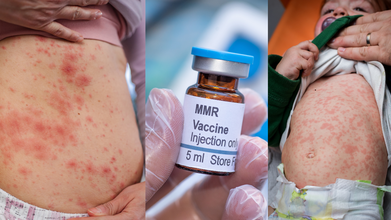
Measles, also known as rubeola, is an extremely contagious viral illness that typically causes high fever, cough, runny nose, red and watery eyes, and a characteristic rash that begins on the face and spreads downward across the body. It spreads through respiratory droplets and can lead to severe and sometimes fatal complications, including pneumonia and inflammation of the brain known as encephalitis.
Although it is preventable through the safe and effective MMR vaccine, measles remains a serious threat in many regions. There is no specific cure, and treatment focuses on managing symptoms, according to the Cleveland Clinic.
What Are The Symptoms Parents Must Look Out For?
Measles has a high transmissibility, and high measles immunity levels are required to prevent sustained measles virus transmission.
This is why herd immunity for measles could be easily breached.
It easily spreads from one infected person to another through breathes, coughs or sneezes and could cause severe disease, complications, and even death.
Symptoms include:
- High fever
- Cough
- Runny Nose
- Rash all over the body
The most unique symptom or the early sign of measles in the Koplik spots. These are tiny white dots that look like grains of salt on red gums inside the cheeks that appear before the red rash starts to appear on a person's face and then the body.
Read: Unique Symptoms Of Measles In 2026 And How Long Does The Infection Last?
Furthermore, the symptoms of measles are also characterized by the three Cs:
- Cough
- Coryza or runny nose
- Conjunctivitis or red and water eyes
How Long Does The Infection Last?
The progression of the symptom comes in two stages, first is the prodromal stage or Days 1 to 4, where one would notice high fever, cough, runny nose, red and watery eyes, sore throat, fatigue, and Koplik spots.
The second stage is called the rash stage or the days 5 to 10 or even more where rash start to appear on the hairline, and then it runs down the body. It lasts for several days and fades in the same order.
The first symptoms, notes the Centers for Disease Control and Prevention (CDC), appear 7 to 14 days after a measles infection. Often, it could also lead to ear infection, or even diarrhea. Though these complications happen in every 1 in 10 children or individual with measles.
Parents Across the U.S. Report Difficulty Finding Mental Health Care for Their Child

Credits: Canva
As per the American Psychological Association (APA), only 58.5 per cent of US teens always or usually receive the social and emotional support they need, as per the report by the US Centers for Disease Control and Prevention (CDC).
Another National Institutes of Health (NIH, US) report notes that the most mental health disorders among children ages 3 to 17 in 2016 to 2019 were attention deficit disorder (9.8%, approximately 6 million), anxiety (9.4%, approximately 5.8 million), behavior problems (8.9%, approximately 5.5 million), and depression (4.4%, approximately 2.7 million). For adolescents, depression is concerning because 15.1% of adolescents ages 12-17 years had a major depressive episode in 2018-201.
However, not all are able to receive the help, in fact, parents too find themselves struggling when it comes to helping their children.
Despite growing concern about a mental health crisis among young people in the United States, a large national study suggests the care system continues to fall short for many families.
Researchers from the Harvard Pilgrim Health Care Institute in Boston found that nearly one quarter of children who require mental health treatment are not receiving it.
The findings come from survey data collected from more than 173,000 households between June 2023 and September 2024.
Many Families Recognize the Need but Cannot Get Help
The analysis showed that about one in five households, or 20 per cent, had at least one child who needed mental health support. Yet among those families, nearly 25 per cent said those needs were not met.
Even families that eventually obtained care often faced significant hurdles. Nearly 17 per cent described the process as difficult and exhausting.
The research letter was published February 16 in JAMA Pediatrics.
Household Structure Shapes Access
The study found that family circumstances strongly influenced how easy it was to navigate the health care system.
Families with multiple children reported higher unmet needs at 28 per cent, compared with 21 per cent in households with only one child. Single parent households also reported more difficulty securing appointments.
Education setting played a role as well. Homeschooled children had higher unmet needs at 31 per cent compared with 25 per cent among children attending public school. Researchers suggest this may reflect the absence of school counselors and other school based support systems.
Insurance and finances created additional barriers. About 40 per cent of families covered by Medicaid or without insurance said they could not get care specifically because it was too hard to access.
In a news release, lead author Alyssa Burnett said nearly one quarter of parents reported that at least one child did not receive needed mental health care, highlighting persistent access gaps.
Cost, Availability and Logistics Remain Major Obstacles
Researchers noted several common barriers. Families cited treatment costs, a shortage of clinicians and logistical issues such as scheduling and travel.
The study also found disparities among racial and ethnic groups. Families from minority backgrounds had higher rates of unmet needs compared with non Hispanic white households. However, Black households reported less difficulty accessing care at 13 per cent compared with 17 per cent among white households.
Bringing Care Closer to Families
Experts involved in the study say improving access may require shifting where care is delivered.
Senior author Hao Yu, an associate professor of population medicine at the institute, said states should expand the child mental health workforce and integrate mental health services into primary care settings to remove barriers and improve access to needed treatment.
Stay Alert During Pregnancy: Common Infections Women Should Watch Out For

A majority of women may experience infections during the crucial phase of pregnancy. Some infections during pregnancy may also not show clear symptoms. However, timely awareness and prevention can protect both the mother and the baby.
Pregnancy is a special and sensitive phase in a woman’s life. While most women focus on nutrition and regular check-ups, infections during pregnancy can often be neglected.
Some infections may cause only mild symptoms in the mother but can seriously affect the unborn baby if not detected early. Hence, regular screening, good hygiene, and timely medical care are crucial to prevent most pregnancy-related infections and ensure a safe and healthy pregnancy.
Common Infections During Pregnancy
- Urinary Tract Infections (UTIs)
- Vaginal infections
- Respiratory infections
- TORCH infections
- Hepatitis B and C can be passed from mother to baby during childbirth if not properly managed.
Tips To Follow To Prevent Infections During Pregnancy
- Pregnant women should go for regular antenatal check-ups, maintain good personal hygiene, and not use any chemical-laden products.
- Stay hydrated and drink enough water, eat home-cooked food, avoid raw or undercooked items, wash your hands frequently, and get vaccinated as recommended by the doctor.
- Take a flu shot on a priority basis. Avoid contact with rodents and pets.
- Make sure to consult the expert in case of symptoms such as fever, pain, or unusual discharge for prompt intervention.
- Get tested for sexually transmitted diseases (STDs) such as HPV, chlamydia, gonorrhea, herpes, syphilis, and trichomoniasis.
- Early detection and treatment will be beneficial in safeguarding both mother and baby and ensuring a healthy pregnancy.
- Follow Us :


© 2024 Bennett, Coleman & Company Limited