
- Health Conditions A-Z
- Health & Wellness
- Nutrition
- Fitness
- Health News
- Ayurveda
- Videos
- Medicine A-Z
- Parenting
Trying To Get Fit In 2026? Here’s A 6-Step Weight-Loss Plan From A Fitness Coach

Credits: Canva
When it comes to losing weight, most people put all their energy into workouts and diet plans, often forgetting one crucial part of the process: mindset. How you think about fitness, food, and consistency plays a major role in whether weight loss feels like a struggle or becomes a sustainable habit. Shifting your approach can make shedding extra kilos feel more manageable and long-lasting.
If staying healthy and losing weight are the goals for the coming year, Raj Ganpath, a fitness coach with over 18 years of experience and the founder of The Quad in Chennai, shares six simple but effective principles to keep in mind. He outlined these points in an Instagram post on 29 December.
6-Step Weight-Loss Plan From A Fitness Coach
1. Eat Less
“You need to eat less,” Raj says plainly. However, he said that this does not mean starving yourself or cutting out all your favourite foods. Instead, it is about being mindful of portion sizes and recognising how often we tend to overeat without realising it. According to him, consistent overeating is one of the most common reasons people struggle to lose weight. Paying attention to how much you eat, even when the food is healthy, can make a noticeable difference over time.
2. Eat Well
Eating less alone is not enough if the quality of food is poor. Raj explains that eating well means choosing nutrient-dense foods that support your body. This includes prioritising protein, vegetables, and whole foods, while reducing items that offer little nutritional value. Sugary snacks, deep-fried foods, and heavily processed or starchy items may be comforting, but they do not help when weight loss is the goal. Making better food choices more often than not builds a strong foundation for fitness.
3. Exercise Regularly
Consistency matters more than intensity. Raj advises exercising at least three days a week, with an ideal range of five to six days if possible. The exact form of exercise is less important than showing up regularly. However, he stresses that strength training should be included at least twice a week. Building muscle supports metabolism and overall strength, making weight loss more effective and sustainable in the long run.
4. Move Often
Exercise sessions alone are not enough if the rest of the day is spent sitting. Raj encourages regular movement throughout the day, separate from structured workouts. Simple activities like walking more frequently can add up. He suggests aiming for at least 6,000 steps daily, with 8,000 or more being a better target. This kind of movement supports fat loss, improves circulation, and keeps the body active beyond the gym.
5. Sleep More
Sleep is often ignored, yet it plays a direct role in weight management. “Most of us don’t sleep enough,” Raj points out. Even going to bed 20 to 30 minutes earlier each night can help. He recommends a minimum of six hours of sleep, with seven hours being ideal. Proper rest supports hormone balance, recovery, and energy levels, all of which influence appetite, motivation, and workout performance.
6. Manage Stress
Stress is unavoidable, and Raj acknowledges that no one can live a completely stress-free life. What matters is how stress is handled. Managing stress allows you to stay consistent with healthy habits instead of turning to food, skipping workouts, or neglecting sleep. Whether it is through exercise, meditation, time outdoors, or personal downtime, finding ways to cope with stress is essential for long-term health and weight loss.
Diet And Exercise Works Together For Weight Loss
Weight loss is most effective when diet and exercise work hand in hand. Diet helps create the calorie deficit needed for fat loss, while exercise protects muscle mass, boosts metabolism, and improves heart and bone health.
Strength training is especially important because muscle burns more calories at rest. While diet controls calorie intake, exercise prevents muscle loss, which can otherwise slow metabolism. Together, they create a balanced and sustainable approach that supports lasting results, healthier habits, and reduced chances of regaining weight.
Astronauts Have To Exercise In Space Every Day: How Zero Gravity Affects Their Hearts

Credit: AI
Physical fitness isn’t the only reason why astronauts exercise in space. Their daily workouts are a medical necessity meant to protect the heart, muscles and bones from the effects of microgravity.
New research based on 13 astronauts suggests that this strategy may be working.
Echocardiograms taken during six-month missions showed that the astronauts experienced mild changes in heart structure and function after entering microgravity, but these changes stabilised during the mission and returned to normal after they came back to Earth. The findings were published in Circulation.
The results are particularly important as space agencies prepare for longer missions, including journeys to Mars.
What Does Zero Gravity Do To The Heart?
On Earth, gravity constantly pulls blood and other body fluids towards the lower half of the body. In microgravity, that pull largely remains absent.
As a result, fluids shift towards the chest and head. The cardiovascular system initially receives more blood than it is accustomed to handling, but over time the body adapts by reducing blood volume. The heart also does not have to work against Earth's gravitational shift in the same way.
NASA says this can reduce cardiovascular function and contribute to problems like low blood pressure and dizziness when astronauts return to Earth.
Longer missions can make these changes more concerning. NASA notes that cardiovascular deconditioning can begin within days of entering a low-gravity environment.
Astronauts Exercise For Around 2 Hours A Day
Astronauts aboard the International Space Station use a treadmill, stationary bicycle and resistance-training equipment.
NASA says crew members currently average around two hours of exercise per day, while another NASA health-care overview schedules astronauts for about 2.5 hours of daily exercise, including time for preparation and recovery.
The goal is not simply to burn calories. Aerobic exercise helps maintain cardiovascular fitness, while resistance training provides mechanical loading that the body no longer receives naturally from Earth's gravity.
NASA describes exercise as a vital practice for maintaining astronaut health and performance in low to zero gravity.
Also read: Are Gaming Chairs Actually Bad For Your Back? Why Cushioning, Posture And Long Sitting Matter
What Did The New Study Find?
The researchers went beyond measuring astronauts' heart rate and blood pressure. The crew members were trained to perform their own echocardiograms, allowing researchers on Earth to remotely guide them through ultrasound imaging of the heart while they were in space.
The scans showed that the heart adapted to microgravity, but the changes did not continue worsening throughout the six-month missions. After returning to Earth, the astronauts' cardiac structure and function returned to their earlier state.
Benjamin Levine, NASA cardiologist, said the findings were “really reassuring” for future Mars missions. He noted that when astronauts were exposed to simulated Martian gravity, equal to three-eighths of Earth's gravity, none showed a cardiovascular response more stressed than standing upright on Earth before the mission.
Essential For Longer Space Missions
A Mars mission would be far longer than a typical six-month stay aboard the ISS.
A planned mission could involve roughly six months travelling to Mars, an extended stay followed by another six-month journey home.
The heart therefore cannot simply rely on the possibility of recovering after returning to Earth.
Levine said future spacecraft will need exercise equipment capable of preserving “the entire spectrum of human adaptation to physical activity”, including the heart, skeletal muscles, bones, and even mental health.
Are Gaming Chairs Actually Bad For Your Back? Why Cushioning, Posture And Long Sitting Matter

Credit: AI
One of the myths about chairs is that the more cushion you have, the better the support. However, comfort and support are not the same thing. A soft feeling chair may allow the body to sink into a position that is not in proper alignment of the spine, pelvis, neck and shoulders.
Gaming chairs often come with plush padding, deep seats, high backrests, and reclining mechanisms. These features may make the chair cozy for long gaming sessions. But this comfort can be at the expense of posture if the chair does not have enough lumbar support or the person is sitting in a slumped posture. The problem isn’t necessarily that a gaming chair is soft. The bigger issue is how the chair supports the body and how long the person sits in the same position.
How Long Hours Of Sitting Can Strain The Spine
When person sit for hours on end, the muscles that support the spine are working non-stop to maintain the correct posture. A backward roll of the pelvis and rounding of the lower back can put additional strain on the muscles and structures that surround the spine.
This can lead to pain, stiffness and discomfort in the lower back over time. Sometimes a firm office chair can provide a more stable base and help maintain a neutral sitting position. This does not mean that a hard chair is healthier than all gaming chairs, but that the right firmness and support might be better than too much padding that allows the body to sink.
The position of the lower back is especially important. The chair should curve to fit the natural curve of the lower back. Feet should be comfortably on the floor and hips and knees should be in a comfortable position. A bad sitting posture can also affect the neck and shoulders. If the monitor is placed too low, the head will move forward and downward. This may result in a stiff neck, shoulder pain and headaches over the following several hours.
Why An Expensive Gaming Chair Cannot Fix Long Sitting
Another myth is that buying an expensive gaming chair automatically solves the problem of long sitting. A chair’s appropriateness is not dependent on the amount of cushioning. The height of the chair should correspond to the height of the person, the proportions of the body, the arrangement of the desk, and the daily activity.
More importantly, no chair can make long, uninterrupted sitting healthy. Those who work or game for several hours should get up regularly, walk a few minutes, stretch and change their sitting position.
Persistent back pain, numbness, tingling, weakness or pain traveling into the legs should not be simply put down to the chair and may require medical assessment. So, the healthiest chair may not be the softest or most expensive one. It’s the chair that gives good support, allows natural movement and doesn’t leave one in one position for too long.
By Dr. Mohit Muttha, Consultant Spine Surgeon, Manipal Hospital Kharadi
Physiotherapy Day – Are Hourly Breaks Enough To Minimise Risks From Prolonged Sitting: Doctors Warn Office Workers
Credit: AI
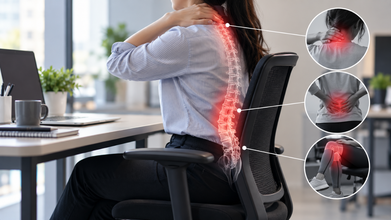
Millions of office workers spend eight to 10 hours at a desk on a regular basis. While sitting in one place may seem harmless, staying in the same position for prolonged periods can gradually affect muscles, joints, mobility and even metabolic health. Those are some of the reasons why experts call "sitting the new smoking".
Physiotherapists agree that the problem is not just 'bad posture'. The bigger concern is spending too much time without changing positions or moving your body.
HealthandMe spoke to Dr. Swapnil Keny, Consultant Orthopaedics & Joint Replacement, Fortis Hospital, Kalyan and Dr. Preeti Tare, Physiotherapist, P. D. Hinduja Hospital and Medical Research Centre, Khar about what office workers need to do to minimise the risks from sitting for prolonged periods.
Effects Of Prolonged Sitting
Dr. Swapnil Keny explains, "When sitting at a place becomes uninterrupted and constant posture, it builds pressure on the muscles of the neck, shoulders, back, and hips. The hip flexor muscles may become tight, and the glutes muscles along with other postural muscles may become inactive. The effects are not limited to the spine: prolonged sedentary behaviour is also associated with poorer metabolic and cardiovascular health."
Dr. Preeti Tare similarly points out that the earliest consequence may simply be a reduction in movement rather than an obvious injury.
Dr. Tare says, “The first change I notice is usually not an injury, but reduced movement. The hip and ankle joints spend hours in limited positions, while the glutes, deep abdominal muscles and upper-back muscles contribute less. The neck and shoulders compensate, especially when we lean towards a screen. Over time, this can reduce joint mobility, muscle endurance, and tolerance for everyday movement. Prolonged sitting can also affect blood circulation and metabolic health, so the impact goes well beyond back pain.”
Also read: That 3 PM Energy Crash May Be More Than Work Stress: Are You Missing Key Nutrients?
One Habit Experts Want Office Workers To Change
If there is one change office workers should make, both experts agree that it is to stop sitting continuously for hours.
“I would ask office workers to stop sitting continuously for hours. Set a reminder to stand up, walk a little or change position regularly. This simple habit reduces the time the same muscles and joints remain under static load. It is more useful than trying to maintain a “perfect” posture all day,” says Dr. Keny.
Dr. Tare recommends being even more proactive rather than waiting for discomfort to appear. She says do not wait for symptoms to appear. From time to time, make it a habit to get up and move around consciously.
These small changes, like walking to speak to a colleague instead of sending a message, standing during a phone call or taking the longer route to refill a water bottle, can help break up prolonged periods of inactivity and alleviate risks.
She says, “Break up sitting before your body starts complaining. Don’t wait for back pain or stiffness to remind you. Every 30–45 minutes, get up, walk to refill your water, speak to a colleague, or simply move around for a couple of minutes. From a physiotherapy perspective, frequent movement is important because tissues respond better to changing loads than to staying in one position for hours. The best posture is ultimately your next posture.”
Also read: World Physiotherapy Day - Beyond Surgery: Why Physiotherapy Decides How Well You Really Heal
Is An Hourly Break Really Enough?
One of the most important points office workers must remember is that moving around once every hour is bare minimum. It should also not become an excuse for remaining inactive for the rest of the day.
“Hourly breaks are a good starting point, but they are not a complete solution. The total amount of movement across the day matters too. A few minutes of walking every hour cannot fully replace regular exercise, walking during breaks and an active commute. Think of movement as a daily habit, not just a reminder on the computer,” says Dr. Keny.
Dr. Tare agrees that movement breaks and overall physical activity play different roles. In other words, the goal should be to reduce sedentary time while also building regular physical activity into the day.
“Both matter, but they serve different purposes. Short movement breaks interrupt the long, uninterrupted periods of sitting, while your overall daily activity builds strength, endurance and cardiovascular fitness. Someone who gets up every hour but remains inactive outside work is still largely sedentary. I encourage patients to think in layers: break up sitting during work, walk whenever possible, and include structured exercise during the week. No single movement break can compensate for an otherwise inactive day.”
Routine Movement For Desk Workers
Office workers do not necessarily need elaborate exercises between meetings. Instead, experts recommend weaving frequent movements throughout the existing workday.
“It is good practice to sit and stand alternatively and walk while on calls wherever feasible, throughout the day. Add a few gentle exercises such as shoulder rolls, neck movements, hip stretches and repeated sit-to-stand movements. Outside work, aim for regular walking and exercise. The idea is not to work out at your desk, but to maintain the movement of the body all the time,” says Dr. Keny.
Dr. Tare suggests a similar approach built around consistency rather than intensity. Desk workers need to stop treating movement as a separate activity.
Stand during calls, walk during breaks, change sitting positions, take regular short walks and incorporate simple movements throughout the workday.
“I prefer a routine that is realistic enough to follow every day. Alternate between sitting and standing, take a short walk every 30–45 minutes and use phone calls as opportunities to move. Twice or three times during the day, do a few sit-to-stands, shoulder movements, gentle spinal rotations and calf raises. Walk during your lunch break if possible. The aim isn't to turn your workstation into a gym; it is to prevent eight hours from becoming eight hours of almost no movement.”
- Follow Us :


© $2026 Times Horizon Private Limited