
- Health Conditions A-Z
- Health & Wellness
- Nutrition
- Fitness
- Health News
- Ayurveda
- Videos
- Medicine A-Z
- Parenting
Weight Loss Alert: Is Coffee the Cheapest Fat Burner? Here's What A Doctor Says

Credits: Canva
Scroll through social media and you will find coffee being sold as the ultimate weight-loss hack. No supplements, no fancy diets, just a cup of coffee that promises to burn fat fast. But is coffee really the cheapest fat burner, or is this another half-truth dressed up as wellness advice?
According to Dr Prabhat Ranjan Sinha, Senior Consultant, Internal Medicine, Aakash Healthcare, who spoke to Health and Me, coffee does have a role in weight management, but the claims around it are often exaggerated and misunderstood.
How Caffeine Actually Works In The Body
Caffeine, the main active compound in coffee, stimulates the central nervous system. This stimulation causes a short-term increase in metabolism. “Caffeine can increase thermogenesis, which is the process by which the body burns calories to produce heat,” Dr Sinha explains.
This metabolic boost, however, is modest. Studies show it may slightly increase energy expenditure for a short period, particularly in people who do not consume coffee regularly.
Coffee is also linked to fat burning because caffeine promotes lipolysis, the process where fatty acids are released into the bloodstream and used as energy. “That is why coffee is often associated with fat burning, especially when consumed before workouts,” says Dr Sinha. This is also why black coffee is commonly used as a pre-workout drink.
Appetite Suppression And Calorie Control
Another reason coffee is popular in weight-loss circles is its appetite-suppressing effect. Caffeine can reduce hunger temporarily and slow gastric emptying, which may help people eat less.
“Black coffee has almost no calories and can replace high-calorie beverages if consumed without sugar, cream, or syrups,” Dr Sinha notes. Swapping sugary drinks for plain coffee can help create a calorie deficit, which is essential for weight loss.
But this benefit disappears when coffee is turned into a dessert-like drink loaded with sugar, flavored creamers, and whipped toppings.
Why Coffee Is Not The Magic Solution
Despite these effects, Dr Sinha is clear that coffee alone cannot lead to sustainable weight loss. “The metabolic boost from caffeine is small and temporary, and the body gradually develops tolerance,” he says. Regular coffee drinkers may not experience the same fat-burning effects as occasional consumers.
Relying on coffee without addressing overall diet, physical activity, and sleep is unlikely to produce lasting results.
When Coffee Starts Working Against Weight Loss
Excessive caffeine intake can backfire. High amounts may raise cortisol levels, a stress hormone that, when elevated chronically, is linked to fat storage, especially around the abdomen. Coffee can also disrupt sleep, and poor sleep is strongly associated with weight gain, increased appetite, and insulin resistance.
Balanced Approach Matters The Most
“Weight loss should always be viewed as a long-term, balanced process,” Dr Sinha emphasizes. Adequate protein, fiber-rich foods, healthy fats, regular exercise, and good sleep matter far more than any single drink.
Coffee can support a healthy routine when used strategically, such as drinking black coffee before exercise, but it should never replace lifestyle habits.
Coffee is not a miracle fat burner. It can be a low-cost, helpful addition to a weight-loss plan if consumed in moderation and without added sugars or fats. “Think of coffee as an addition, not a cure,” Dr Sinha says. Setting realistic expectations is key to healthier and more sustainable weight control.
Starbucks Gets Sued Over ‘Sugar-Free’ Protein Drinks Containing Up To 21 Grams Of Sugar: Health Risks Explained

Credit: iStock
Starbucks is facing a class-action lawsuit in the US for marketing eight protein beverages as "sugar-free" despite containing between 13 and 21 grams of sugar in a venti serving. The lawsuit filed in Seattle states the drinks are labelled in a misleading manner that violate federal regulations. In response, Starbucks has denied the claims.
According to Reuters, the sugar comes from lactose, the naturally occurring sugar in milk, rather than sugar added to the beverages. Starbucks says the drinks contain no added sugar and that their nutritional information is available on its website and other platforms.
About The Starbucks Lawsuit
Also read: Nearly 1 In 4 US High School Seniors Drink Energy Drinks Daily: Doctors Warn About Caffeine Risks
Hagens Berman filed the suit on behalf of three consumers who bought Starbucks’ sugar-free protein drinks in California, New York and Washington.
“Consumers avoid sugar for various reasons, whether that be general health, diabetes and blood glucose levels or other factors, and for many, a staunch mislabeling like this is significant,” said Steve Berman, a co-founder and managing partner of the Seattle-headquartered firm.
The drinks named in the lawsuit include sugar-free vanilla and caramel protein lattes and matchas, along with their iced versions. Starbucks' U.S. website listed a 16-ounce (0.5-liter) Sugar-Free Caramel Protein Matcha with 16 grams of sugar and a 20-ounce (0.6-liter) version of the same drink with 21 grams of sugar.
The drinks are marketed as “sugar-free,” but the amount of sugar in each beverage was also mentioned, including a note that said that they were made without added sugar.
“We believe these claims have no merit,” a Starbucks spokesperson said Monday. “Starbucks has consistently and clearly provided information about its protein beverages, sugar-free options, customization choices and nutritional content across product announcements, menus, marketing materials, Starbucks.com and the Starbucks app, and we intend to vigorously defend ourselves in this matter.”
Naturally Occurring Sugar Vs Added Sugar
Also read: Red Bull Vs FSSAI: Beverage Giant Can Retain The 'Energy Drink' Label; What Are Its Health Risks
The American Heart Association says that naturally occurring sugars are found in foods like milk and fruit, while added sugars are added during the preparation. Lactose in milk is therefore not the same as added table sugar or syrup.
However, “naturally occurring” does not mean the amount is irrelevant or it is completely healthy. Total sugar still contributes carbohydrates and calories, and affects the overall nutritional profile of a beverage.
Health Risks Of Consuming Excessive Sugar
High consumption of sugary foods and beverages can contribute to excess calorie intake and obesity. Excess sugar intake is also linked with a higher risk of conditions including type 2 diabetes and cardiovascular disease. WHO also identifies sugar consumption as a major risk factor for dental caries.
The American Heart Association recommends limiting added sugar to no more than 25 grams per day for most women and 36 grams for men.
Therefore, a drink containing 21 grams of naturally occurring sugar cannot simply be counted as 21 grams of added sugar, but the number still gives consumers useful information about what they are drinking.
Naturally added sugars do not make it fit for consumption, especially for someone monitoring blood glucose. Lactose is a carbohydrate and is broken down into glucose and galactose during digestion.
Therefore, people with diabetes or those specifically trying to control their carbohydrate intake may still need to account for the total carbohydrate and sugar content of a drink rather than trusting terms such as “sugar-free” or “no added sugar.”
PCOS and Nutrition: Why Eating Healthy Is About Balance, Not Cutting Foods

Credit: AI
A 20-year-old girl came in with a three-year history of missing periods, sometimes for three to four months at a stretch. She had also noticed increasing facial hair, a common sign of hormonal imbalance. She was thin-looking and had a normal body weight, with no history of significant weight gain. Further evaluation, however, showed that she had PCOS along with metabolic abnormalities.
Her case highlights an important misconception: PCOS does not always come with weight gain. Women with normal body weight can also develop the condition, and appearance alone cannot determine whether someone has PCOS.
Why Can Symptoms Persist Despite Eating Healthy?
Many women with PCOS focus on eliminating sugar, carbohydrates or processed foods, but overlook whether their diet provides enough protein, fibre and essential nutrients. PCOS can affect menstrual cycles, ovulation, androgen levels and metabolic health, and insulin resistance does not affect everyone in the same way.
Diet is also only one part of management. Hormonal factors, physical activity, sleep, genetics and individual metabolic health can influence symptoms. Persistent symptoms do not necessarily mean that someone is eating incorrectly.
Build a Balanced Plate Instead of Cutting Foods
Poha, upma, idli, rice and roti can all be part of a balanced diet. The focus should be on the overall meal rather than eliminating familiar foods.
A balanced meal can include:
- Protein such as dal, curd, paneer, tofu, eggs, beans or sprouts
- Vegetables, whole fruits and other fibre-rich foods
- An appropriate portion of whole or minimally processed carbohydrates
- Healthy fats from nuts and seeds
Carbohydrates do not need to be eliminated. Pairing them with protein and fibre can improve satiety and contribute to better overall metabolic health.
Also read: Ozempic, Wegovy & PMOS: How GLP-1 Drugs Are Changing PMOS Treatment?
Common PCOS Diet Myths
One common myth is that every woman with PCOS needs to follow a very low-carbohydrate diet. Another is that being thin means PCOS is unlikely. Neither reflects the full picture.
Overly restrictive diets can also result in inadequate nutrition and may be difficult to sustain. The goal should be a balanced eating pattern rather than a growing list of foods to avoid.
Do Not Overlook Essential Nutrients
Iron may require attention when menstrual bleeding is heavy or prolonged, while vitamin B12 can be relevant when animal foods are limited. Calcium and vitamin D are also important when dietary intake is inadequate. Supplements should be considered according to individual needs and medical advice rather than taken routinely.
Also read: Why Rebranding PCOS As PMOS Could Mark A New Era In Women’s Health
Management Goes Beyond Diet
Regular physical activity, adequate sleep and a consistent routine can support overall metabolic health. Depending on symptoms and individual needs, medical treatment may also include medicines to regulate periods, manage specific hormonal symptoms, address insulin resistance where appropriate, or support fertility.
PCOS is generally a long-term condition rather than one with a single permanent cure, but its symptoms and associated metabolic concerns can be effectively managed.
When Should You Seek Medical Advice?
Women should consider medical evaluation if they experience:
- Repeatedly irregular periods or gaps of several months
- Increasing facial or body hair or persistent acne
- Difficulty conceiving
- Persistent changes in menstrual or hormonal patterns
The goal of PCOS management is not to eat less or eliminate more foods. It is to understand the individual pattern of symptoms and build sustainable habits that support nutritional, hormonal and metabolic health.
By Dr Ranjana Sharma, Senior Consultant, Obstetrics and Gynaecology, Indraprastha Apollo Hospital, Delhi
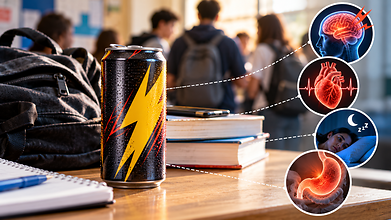
Nearly 1 In 4 US High School Seniors Drink Energy Drinks Daily: Doctors Warn About Caffeine Risks
Credit: AI
The consumption of energy drinks among teenagers has increased in the US. This has sparked concerns among doctors about caffeine toxicity, sleep, heart health, and the effects on their developing brains.
According to the latest federally funded Monitoring the Future survey, 23% of 12th graders said they consumed energy drinks daily. The figure was 20% among 10th graders and 18% among eighth graders.
The findings come as a group of doctors have raised concerns about the growing consumption of energy drinks among young people, particularly after Monster Energy signed a sponsorship deal with the Big 12 Conference, a major US college sports organisation.
The deal puts Monster branding on football and basketball jerseys, fields, courts and digital and social media platforms. Doctors have urged the conference to pause the partnership and called for greater scrutiny of energy drink marketing to young people.
Doctors Are Concerned About Growing Energy Drinks' Consumption Among Teens
Also read: Exclusive: From IPL To Olympics — How Sport Became A Marketing Tool For Junk Food And Sugary Drinks
Dr. Robin Ireland told HealthandMe how marketing unhealthy foods and drinks through sports affects children.
He said, " Sport presents glamour and excitement, and children look up to big performers and superstars who often promote products they probably don't consume themselves because they're not good for sporting performance. Yet their names and images are used to create that excitement and, as you described, a health halo. Brands want to be associated with that healthy image. Athletes think that if they want to perform like a Sachin Tendulkar or another superstar, they need a sports drink or energy drink. And of course, they don't. But that's what the brands are trying to do."
Doctors involved in the campaign say their concern extends beyond Monster and applies to energy drinks as a category.
Dr Matthew Nelson, an Idaho cardiologist told US News, “Kids are going to see energy drinks now promoted by the universities and the athletes that they admire and want to emulate. The kids will think of them as sports drinks, which they’re not.”
Energy drinks can contain large amounts of caffeine. Depending on the product, a single serving can contain 80 to 300 milligrams of caffeine. An eight-ounce coffee typically contains around 80 to 100 mg, while some soft drinks contain 50 mg or less.
The American Academy of Pediatrics recommends that children and teenagers avoid energy drinks and advises those aged 12 to 18 to limit caffeine to no more than 100 mg a day.
Too much caffeine can increase heart rate and blood pressure and may cause sleep problems, agitation, and dehydration. In more severe cases, excessive stimulant intake can contribute to abnormal heart rhythms and seizures.
Dr Tamara Hannon, an Indiana paediatrician and chair of the American Academy of Pediatrics' nutrition committee, described the effect of excessive stimulants on the body.
She said, “The same thing can happen when you deliver stimulants to people. The heart can wear out, the nervous system can go haywire and you can have really serious consequences.”
Monster Energy, meanwhile, has defended its products, saying caffeine and other ingredients in its drinks are also found in many other foods and beverages.
The company said, “Mainstream energy drinks have been marketed worldwide for more than 30 years and more than 100 billion energy drinks have been sold and safely consumed globally.”
The company also said its products carry warnings and that its members do not sell or market energy drinks in K-12 schools.
Also read: Red Bull Vs FSSAI: Beverage Giant Can Retain The 'Energy Drink' Label; What Are Its Health Risks
Teen's Death After Drinking An Energy Drink
In 2017, 16-year-old Davis Cripe of South Carolina died after developing an abnormal heart rhythm following consumption of an energy drink. According to his father, Sean Cripe, Davis had consumed a Mountain Dew and a latte from McDonald's earlier that day before drinking the energy drink. He did not have a known heart condition and was not a regular energy-drink consumer.
“He chugged an energy drink — like, just trying to be cool,” Sean Cripe said. His father later said, “We had talked to him and let him know that they weren’t healthy. We didn’t understand they could be deadly.”
Doctors stress that deaths associated with energy drinks are rare, and Davis' case does not mean every teenager who consumes an energy drink will experience a life-threatening complication. But it illustrates why excessive caffeine consumption can be concerning in young people.
Message For Parents
Teenagers may consume caffeine from several sources in the same day, including energy drinks, coffee, soda and other caffeinated beverages. That can make it difficult to recognise how much caffeine they are actually consuming.
Doctors recommend that parents talk to teenagers about the difference between energy drinks and sports drinks and pay attention to all sources of caffeine in their diets.
The US Centers for Disease Control and Prevention also recommends educating children about the harms of excessive caffeine consumption.
- Follow Us :


© $2026 Times Horizon Private Limited